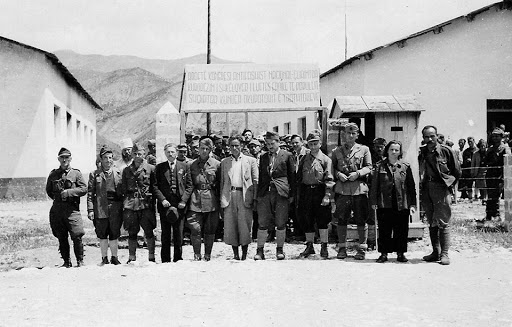
The Congress of Përmet met on 24–28 May 1944, while Albania was under German occupation. Convened by the National Liberation Movement, it established institutions through which the movement claimed national political authority. The congress was a turning point in the transition from wartime resistance structures to the administration led by Enver Hoxha.
The congress and its delegates
The Ministry of Defence’s historical account, published in Ushtria on 24 May 2024, states that 200 delegates were elected. It describes representation from liberated and occupied areas, partisan formations, youth and women’s organisations. Omer Nishani opened the meeting, and Enver Hoxha presented the principal report on the war and the international situation.
Council and Committee: two different bodies
The congress elected the Antifascist National Liberation Council as the highest legislative and executive authority claimed by the movement. The Council then formed the Antifascist National Liberation Committee, with the attributes of a provisional government. The Council and the Committee were distinct institutions.
The Committee had 11 members and was headed by Enver Hoxha. Among the congress’s political decisions were barring the return of King Zog and continuing the struggle against the German occupation. These were decisions of the movement and its delegates; they should not be confused with a nationwide competitive election or with diplomatic recognition by foreign states.
From Përmet to Berat
The next institutional step took place in Berat in October 1944. On 22 October, the Committee was transformed into the Democratic Government of Albania, with Hoxha as prime minister. This occurred before the end of the fighting in Albania, rather than in December.
International recognition was a separate issue
The formation of a government did not automatically secure international recognition. A British Embassy memorandum dated 3 November 1944, preserved in the US diplomatic record, stated that Britain did not then propose to recognise the new provisional government. Its accompanying editorial note dates the formation of the government at Berat to 22 October.
Read together, the institutional sequence and the diplomatic record show why the congress, the formation of a government and international recognition must be treated as separate events.
Sources
National History Museum: Antifascist National Liberation War pavilion; Ushtria, 24 May 2024, p. 10; FRUS, 1944, Volume III, document 203.