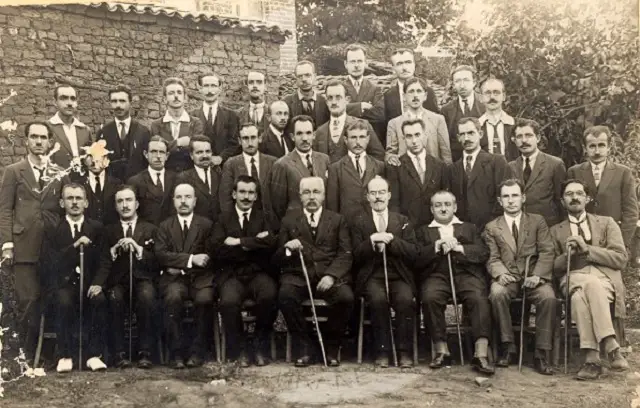
The Congress of Lushnja, held in January 1920, was a decisive stage in the reconstruction of Albanian state institutions after the First World War. Its delegates opposed plans to partition the country and sought to restore national political authority at a time of foreign military presence and diplomatic uncertainty.
A national assembly and new institutions
The Parliament of Albania’s historical account dates the congress to 21–31 January 1920. It credits the assembly with creating a 37-member Senate, subsequently called the National Council. This figure refers to the legislative body chosen by the congress, rather than to the total number of congress delegates.
The congress chose a government headed by Sulejman Delvina. It also established a High Council to exercise the functions of a collective head of state. The four members were Aqif Pashë Elbasani, Mihal Turtulli, Luigj Bumçi and Abdi Toptani. The arrangements were set out in the constitutional framework commonly known as the Statute of Lushnja.
The government’s move to Tirana
The National History Museum records that Delvina’s government and the new institutions settled in Tirana on 11 February 1920. The move established Tirana as the seat of national government and is central to its emergence as Albania’s capital. The government’s relocation should be distinguished from the precise wording of the congress’s decisions.
Parliamentary activity and international standing
The National Council began its parliamentary work on 27 March 1920. According to Parliament’s account, it held two sessions that year, adopted legislation and exercised oversight over the government. These institutional developments formed part of the broader effort to consolidate state authority.
The War of Vlora and diplomatic efforts also shaped the outcome of 1920. Albania’s admission to the League of Nations on 17 December 1920 strengthened its international position. The congress was therefore part of a longer process, rather than a single event that resolved every territorial and political dispute.
A note on the dates
Institutional summaries do not use an identical date range: Parliament gives 21–31 January, while the National History Museum describes proceedings on 29–31 January. For the detailed sequence of meetings, the original minutes remain the appropriate reference.
Sources
Parliament of Albania: institutional history; National History Museum: Independence pavilion; Bajram Xhafa, “Kushtet historike të ngritjes së Mbretërisë Shqiptare”, Studime Historike 3–4 (2009), p. 198.