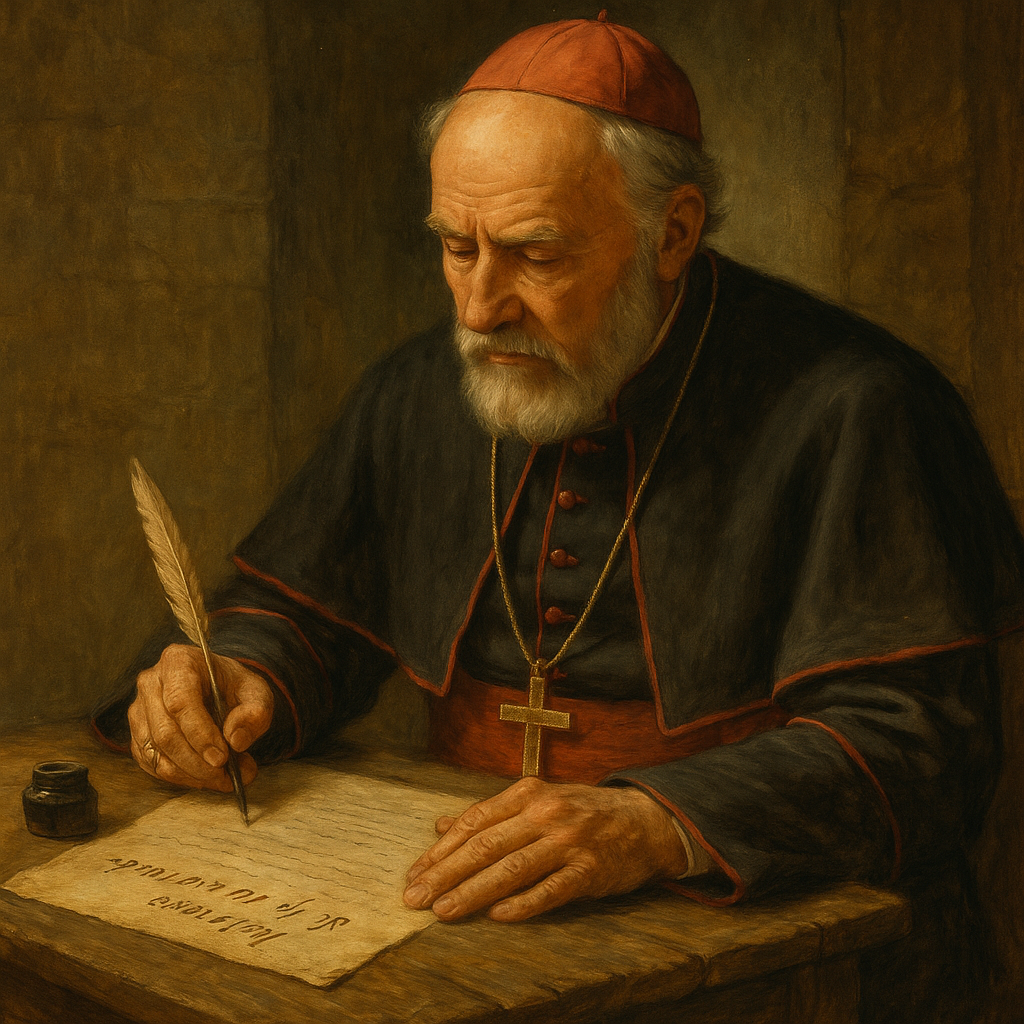
At the height of the European revolution of 1848, a lone priest from Durrës wrote to Rome about the destruction of churches, the poverty of the people, and the resistance of Albanian Catholics under Ottoman rule.
The revolution that did not reach Albanian shores
The year 1848 shook Europe from Paris to Vienna. But while the wind of freedom blew across the continent, Albania remained mired in poverty and under the shadow of the Ottoman Empire. It was at that time that the Archbishop of Durrës, Raffaele D’Ambrosio , sent a long report on the situation of his archdiocese to the Congregation for Propaganda Fide in Rome. This document – preserved today in church archives – is one of the most complete descriptions of the religious, social and moral reality of Albania in the mid-19th century.
The Archdiocese of Durrës: from glory to ruin
In his letter, D’Ambrosio describes an archdiocese that stretched between Lower Albania and Macedonia , a land where, according to him, “the first lights of Christianity were spread by the apostles Saint Andrew and Saint Paul themselves.” But this ancient glory had come to an end. After the death of Skanderbeg, he writes, “under the sword of Mehmet II, Catholicism fell to its knees.” Churches were demolished, altars were desecrated, and believers were forced to renounce their faith.
“With terrible fury,” he writes, “they forced the believers to deny their religion and embrace the Turkish sect, by destroying churches and desecrating altars.”
Korbin Cathedral and the shadows over Durrës
D’Ambrosio mentions with sorrow the cathedral of Korbin , once the spiritual center of Catholics, which in 1848 was ruined and abandoned, “surrounded only by mountains and forests where wolves howled.” In Durrës itself, once a glorious city, only a few Catholic families remained – merchants who kept a faint presence alive in the Adriatic port.
The clergy without training and the people without hope
A large part of the report is devoted to the state of the clergy . The Archbishop explains that his diocese had neither a seminary nor financial resources for the formation of priests. “Priests are few, poor and unprepared,” he writes, “and many villages remain without religious services.” However, the people’s faith had not died out. In the plains, Catholics maintained their devotion to the sacraments, while in the highlands, old customs – cohabitation outside of marriage, mixed marriages and blood feuds – made religious life difficult.
Ottoman injustices and silent resistance
In several parts of the report, D’Ambrosio describes with shock the pressure of the Ottoman government on the Catholic community. In many villages, church bells were forbidden to ring; Catholic girls were forcibly taken and married to Turks; the population paid heavy taxes and faced daily injustice. This situation, he writes, had destroyed the moral structure of society, but “the spirit of religion had not yet been extinguished.”
A small people, a great faith
At the end of the report, the archbishop also gives exact figures: 6,716 Catholics compared to 50,322 Muslims . A small minority that faced oppression and poverty with silent resistance. In this conclusion, D’Ambrosio implies that the religion and identity of the Albanians had remained alive, despite the ruins that surrounded them.
The historical value of the document
Raffaele D’Ambrosio’s account is more than a religious account. It is a reflection of Albanian life under the Ottoman Empire – a mixture of spiritual survival, political pressure and human despair. Today, this evidence is a treasure trove for historians, because it shows us how Albanians in the mid-19th century tried to preserve their identity in a world that was changing violently.