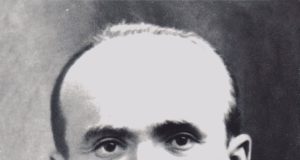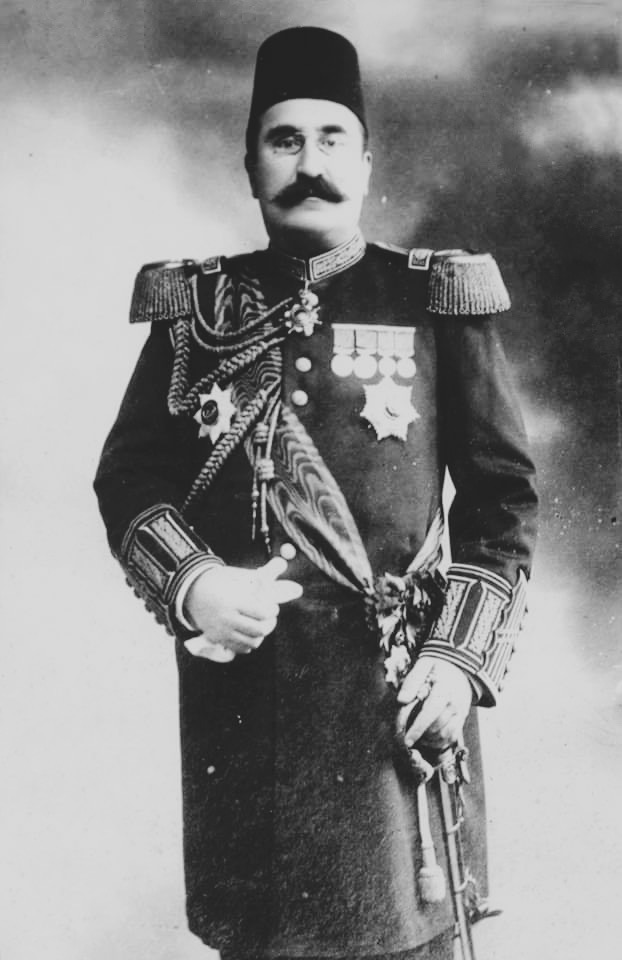
In Albanian history, there are figures who never ruled a declared state, did not sit on official thrones, and did not leave behind royal palaces.
But there were also men who ruled with moral authority, with besa (the pledged word), with tradition, and with a name that weighed more than any decree.
One of them was Preng Bib Doda — the prince of Mirdita.
His story is not simply the story of a noble family, but the junction where they collide:
The Ottoman Empire, the Vatican, France, Austria-Hungary, Serbia, Montenegro and Mirdita itself, this strong Catholic province that for decades was treated as a political and military problem.
This is the story of a man who did not rule a country,
but a collective conscience.
Mirdita was not simply a mountainous region in northern Albania.
For the Ottoman Empire, it was a problematic territory, which:
- had an autonomous tribal structure
- preserved Catholicism in a Muslim empire
- did not fully implement Ottoman administration
- and above all, there was a hereditary leader: the Kapidan of Mirdita
The Bib Doda family was at the head of this structure. The Kapidan was not just a tribal leader – he was:
- judge
- mediator
- military leader
- and political representative of the province in the face of foreign powers
In this context, the figure of Preng Bib Doda is born and formed.
Preng Bib Doda was the son of Bib Doda, Kapidan of Mirdita, a figure known for his authority in northern Albania and for his complicated relations with the Sublime Porte.
After his father’s death, Prenga inherited not only the title, but also a dangerous political burden.
Mirdita was already:
- under constant Ottoman surveillance
- object of interest from Montenegro
- and a strategic point for the Vatican, due to Catholicism
In archival documents from the late 19th century, Preng Bib Doda is mentioned as:
- “Capitano dei Mirditi”
- “Principe dei Mirditi”
- and in some cases as a dangerous political figure, precisely because he represented the unity of a population that did not directly obey Istanbul.
For the Ottoman Empire, a united Mirdita around Preng Bib Doda was an open threat.
For this reason, he:
- was forcibly removed from Albania
- was kept under control
- and for years he lived outside Mirdita, mainly in Istanbul
The documents show that his removal was deliberate. Its aims were:
- to weaken Mirdita
- to disrupt the traditional institution of the kapidanate
- and remove the unifying figure of the province
But the departure of Preng Bib Doda did not weaken Mirdita.
On the contrary, his absence made him a symbol.
In the archives of the Vatican and Western diplomats, Preng Bib Doda appears as an important political figure.
He is mentioned in correspondence with:
- Holy See
- France
- and other diplomatic missions in Constantinople
The documents clearly show that:
- The Vatican saw Prenga as a protector of Albanian Catholics.
- France considered him an influential figure in a strategic area.
- while the Sublime Porte tried to neutralize him without making him a martyr
Some letters also discuss proposals for Preng Bib Doda:
- to administer an Albanian vilayet (province)
- or be included in a broader autonomous structure
None of these were fully realized, but the very existence of these projects shows his political importance.
By the end of the 19th century, the Albanian question was no longer simply a local problem of the Ottoman Empire. It had become an international issue, closely linked to the Balkan balance and the interests of the great powers.
In this context, the figure of Preng Bib Doda clearly emerges in the documents as one of the key points of stability or instability in northern Albania.
Prenga was not a modern-type ideologue, but he represented:
- traditional Albanian autonomy
- besa as a political institution
- and the continuity of the Catholic tribal order
Unlike some other figures of the time, he did not seek immediate secession, but political recognition of Mirdita within a broader autonomous framework.
This is precisely what made him acceptable to some powers and dangerous to others.
One of the strongest political tensions involving Preng Bib Doda was Montenegro’s continued pressure on northern Albanian territories.
Montenegro, occasionally supported by Russia, saw Mirdita as:
- buffer zone
- territory for expansion
- and weak points of the Ottoman Empire
Archival documents mention:
- armed incursions
- incitement of tribal conflicts
- and the attempt to divide Mirdita
In this situation, Preng Bib Doda’s physical absence from Mirdita created an authority vacuum.
The documents themselves state that:
“The absence of the prince of Mirdita has brought increased robberies, insecurity and the weakening of the traditional order”
This is why in several letters addressed to Ottoman authorities and foreign representations, the return of Preng Bib Doda to Mirdita is seen as a political necessity.
One of the most significant elements of this story is the involvement of the Vatican.
In documents preserved in the archives, including letters from senior clerics, Preng Bib Doda is presented as:
- defender of Albanian Catholics
- stabilizing figure
- and symbol of religious continuity in Mirdita
The Holy See attached special importance to Mirdita because it was:
- one of the main bastions of Albanian Catholicism
- surrounded by Muslim and Orthodox territories
- and potentially exposed to religious assimilation
In some letters it is clearly stated that:
- The departure of Preng Bib Doda had brought about a weakening of the religious order.
- foreign priests entered without permission
- and local church authority was in danger
His return was seen not only as a political issue, but as a moral and religious one.
For the Sublime Porte, Preng Bib Doda was a paradox:
- he was a problem because he represented autonomy
- but also a solution because he guaranteed order
For this reason, the Ottoman Empire chose an intermediate path:
- neither physical elimination
- nor full political recognition
- but containment, isolation and diplomatic pressure
This strategy, however, did not extinguish his authority.
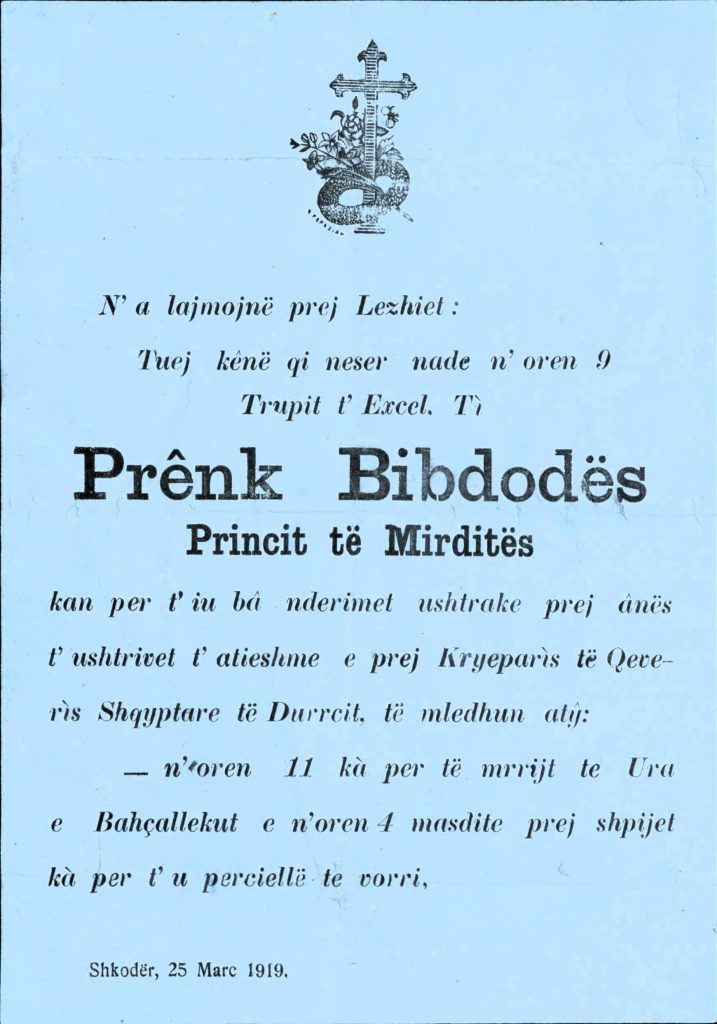
In Mirdita, the name of Preng Bib Doda continued to be mentioned as:
- source of legitimacy
- reference to traditional law
- and symbol of unity
The archives speak more clearly than any later narrative.
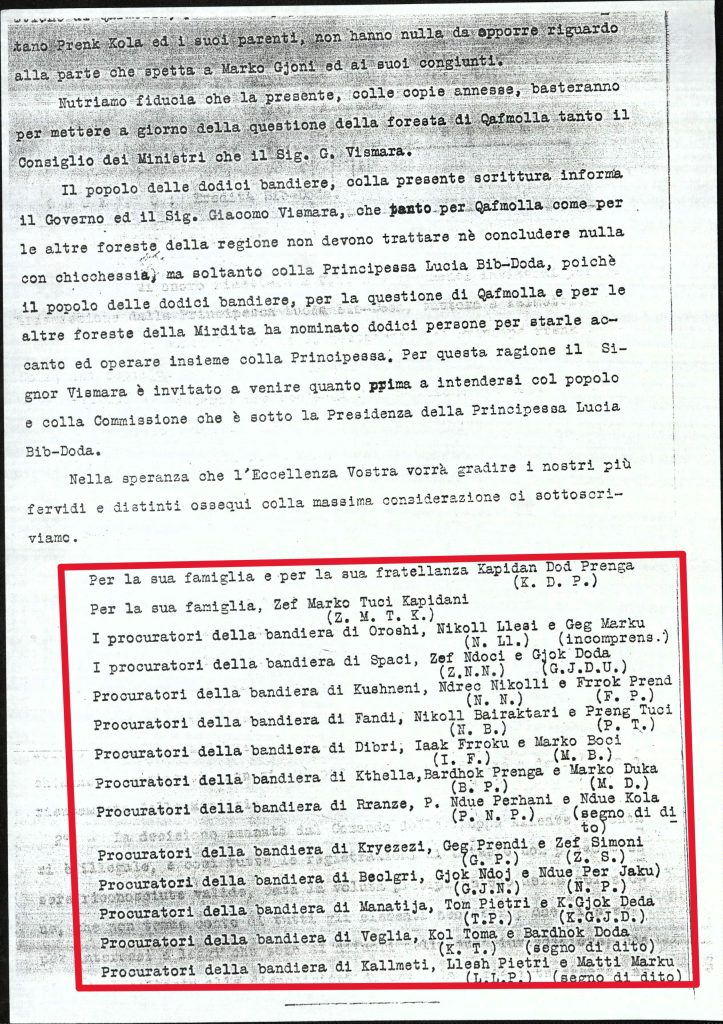
In the archival fonds of Preng Bib Doda, his figure emerges not as a myth, but as a real political actor, involved in a complex network of relationships.
In correspondence with foreign representatives and church authorities, Prenga is often mentioned as:
- “Capitano dei Mirditi”
- “Principe dei Mirditi”
- guarantor of order and besa in a region without modern state administration
Letters from the Legation of France in Constantinople emphasize that French interest in him was related to the fact that:
- Mirdita was a strategic territory
- Preng Bib Doda enjoyed the trust of the population
- and could serve as a factor of stability in northern Albania
In another document, church authors underline that his absence had brought:
- decline in religious discipline
- division between the bajraks (tribal districts)
- and foreign interference in internal affairs
These are not sentimental assessments, but political and religious reports, written for real decision-making.
At the beginning of the 20th century, Albanians were entering a new phase: the creation of a national state.
Here, the paths of Preng Bib Doda and Ismail Qemali intersect in an indirect but significant way.
Ismail Qemali represented:
- the modern state project
- European diplomacy
- and the idea of formal independence
Preng Bib Doda, on the other hand, represented:
- traditional autonomy
- the order founded on besa
- and the moral sovereignty of the province
The documents show that:
- Prenga was not against the Albanian state
- but he wanted guarantees for Mirdita
- and the preservation of traditional privileges
This was not a contradiction, but two forms of legitimacy that sought to coexist.
The death of Preng Bib Doda marks the end of a political model that had survived for centuries in northern Albania.
With his departure:
- Mirdita lost its central figure
- traditional authority was weakened
- and the order of the besa began to be gradually replaced by state administration
But property documents, wills, inheritance deeds and bank correspondence show that Prenga was not a wealthy ruler, but a figure who:
- spent on maintaining order
- held financial responsibility
- and often personally covered the cost of stability
He did not leave behind a principality written in law, but an unwritten political memory.
The story of Preng Bib Doda is not simply a local episode.
It teaches us that:
- Albania has had forms of sovereignty before the state
- authority did not come only from the rifle, but from besa
- and Albanian politics have had different models of legitimacy
At a time when the modern state is often seen as the sole source of order, this story reminds us that:
Once upon a time, order was maintained by the pledged word, rather than written law.
Preng Bib Doda did not rule a state.
He ruled a collective conscience.
He was a prince without a crown, a politician without a parliament, a ruler without a standing army —
but with an authority that survived beyond his lifetime.