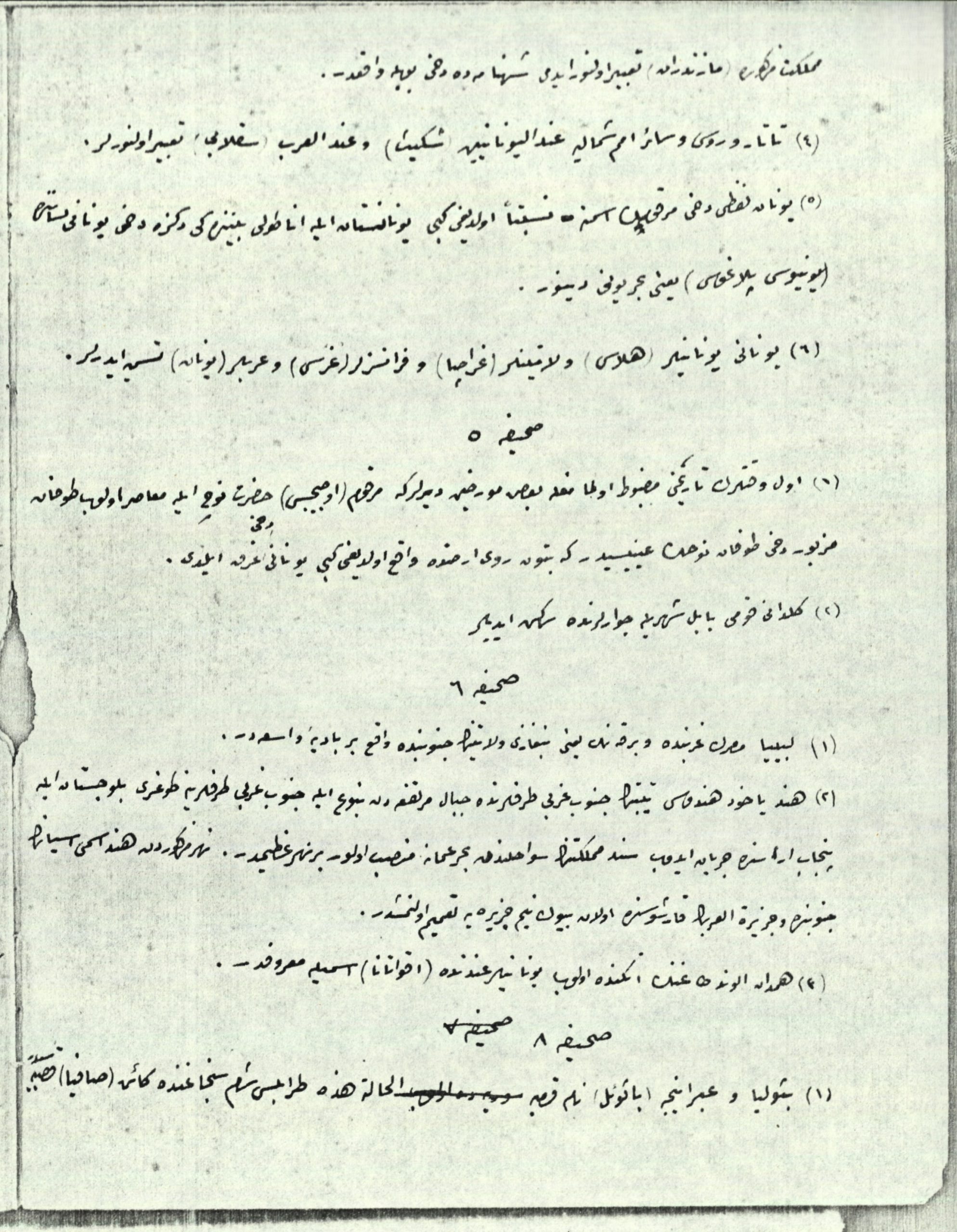
In the manuscript “Tarih-i Kadim”, Sami Frashëri describes ancient Egypt as the cradle of knowledge and civilization, the place where science, architecture, and the first human wisdom were born.
Egypt – the place where knowledge turned into culture
On the third and fourth pages of “ Tarih-i Kadim – Tarih-i Kadim ”, Sami Frashëri dwells with respect and admiration on ancient Egypt , which he calls:
“مهد العلوم و الفنون و مقر الحكم و التمدن.”
(The cradle of sciences and arts, the centre of wisdom and civilisation.)
In his opinion, Egypt was the first school of humanity , the place where knowledge was institutionalized and took shape through astronomy, mathematics, and monumental construction .
He presents the Egyptian people as a nation that turned faith into science and knowledge into a system .
Pharaohs and the organization of the state
Sami Frashëri writes that the pharaohs were “powerful and wise kings” who ruled not only with force, but also with order and law .
In the manuscript we read:
“فرعونيان در اداره ملك مهارت تمام داشتند.”
(The pharaohs had great skill in governing the kingdom.)
He mentions that they built canals, bridges, and temples that “defy the centuries,” and established a developed tax and social system.
Philosophically, the author sees them as a symbol of the union between power and knowledge — something that would later be lost in world history.
Priests and sacred knowledge
A section of great importance is dedicated to the Egyptian priests (علماء دینیه), who, according to the author, were the guardians of the knowledge and secrets of nature .
“كاهنان علم نجوم و طب را در معابد تعليم مى دادند.”
(The priests taught astronomy and medicine in the temples.)
Sami Frashëri describes with amazement the fact that the temple in Egypt was simultaneously a place of worship, a school, and a library .
In this way, he presents the natural connection between religion and science , something he considers the foundation of true civilization.
Architecture and the eternity of stone
A special part of the manuscript talks about the giant constructions of the pharaohs.
The author mentions the pyramids as “works that testify to the power of the human mind,” writing:
“اهرام مصر از آثار عقل و صبر بشر است.”
(The pyramids of Egypt are works of human reason and patience.)
This simple, poetic and philosophical phrase is an example of Sami Frashëri’s lofty language: every monument is a symbol of the eternity of thought , not just of power.
In his interpretation, the Egyptian stone is humanity’s first book — and the pyramid, a page that does not fade with time.
Egypt as a leader of other nations
At the end of these pages, the author states that other peoples, such as the Greeks and Romans, “learned from Egypt”:
“يونانيان و روميّان علوم خود را از مصريان اقتباس نمودند.”
(The Greeks and Romans drew their knowledge from the Egyptians.)
This assessment transforms Egypt into the source of universal civilization .
Clearly, Sami Frashëri affirms that the roots of European civilization are Eastern — a very modern idea for his time.
The moral lesson conveyed by Sami Frashëri
In his encyclopedic style, but always with an ethical spirit, the author concludes that there is no civilization without knowledge and no religion without education .
In a separate line he writes:
“علم اساس ملك است.”
(Knowledge is the foundation of the state.)
This is a saying that transcends the boundaries of history and remains relevant today: any society that builds itself on knowledge survives across the centuries.
Conclusion
Pages 3–4 of “Tarih-i Kadim” are a hymn to Egyptian civilization , with each line carrying a lesson in knowledge, faith, and construction.
Sami Frashëri sees Egypt not as a distant land of myths, but as a lasting example of human development .
“تمدن مصر، پايه علوم عالميه است.”
(Egyptian civilisation is the foundation of universal knowledge.)
These words summarize his entire thought: culture, knowledge, and justice are the pillars upon which history is built.
Source: Manuscript “Tarih-i Kadim” – p.3–4
Prepared for Historiani.com
#SamiFrashëri #AncientEgypt #Historiani #Pharaohs #AncientHistory #OttomanManuscript