In the manuscript “Tarih-i Kadim”, Sami Frashëri describes the origin of man and the birth of the first civilizations, from Adam to the Babylonians, giving an oriental vision of universal history.
The origin of man and the beginning of history
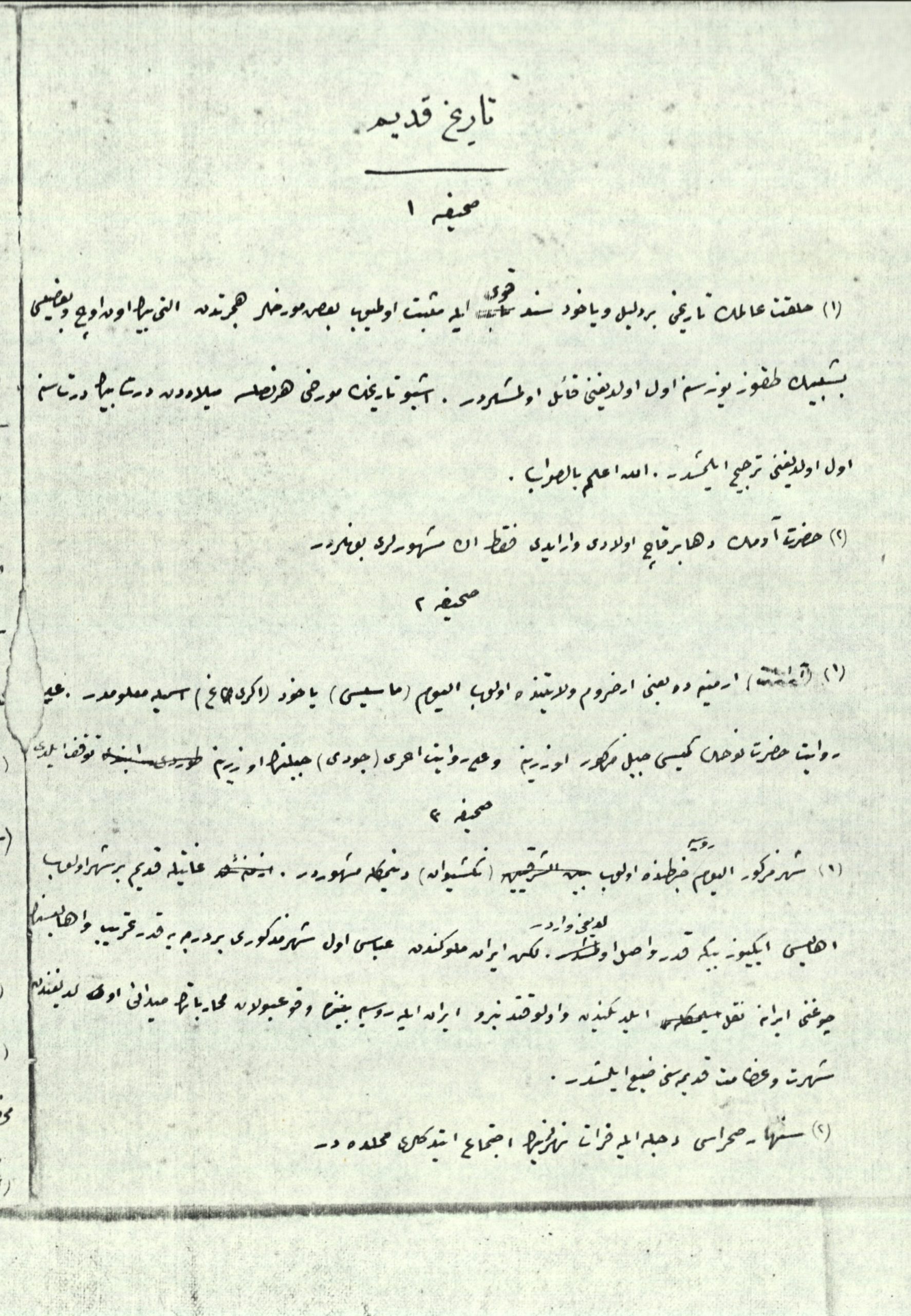
In the first pages of the manuscript “ Tarih Qadim – Tarih-i Kadim ”, Sami Frashëri opens a window on the beginnings of humanity.
He writes:
“خلق عالم انسانى ناچيز بيد قدرت الهى بوجود آمده…”
(Man, this small creature, was brought into being by the hand of divine power…)
The author sees history not as a series of cold events, but as a flow ordered by God , where every people and every civilization has a divine mission.
In these lines he combines religious faith , scientific education , and philosophical thought , describing man as a being endowed with reason, mind, and a searching spirit.
The first peoples and civilizations of the East
The manuscript mentions the names of the first civilizations that marked the first steps of humanity:
“بابلیان و آشوریان و مصریان…”
(The Babylonians, Assyrians and Egyptians…)
Sami Frashëri calls these “peoples of ancient knowledge,” who built temples, roads, irrigation systems, and an organized society before Europe was born.
In his interpretation, the East is the mother of knowledge , and Babylon – the first cradle of world civilization.
He mentions that the first sciences of astronomy and mathematics were created in Babylon, writing:
“اهل بابل علم نجوم را اختراع نمودند…”
(The people of Babylon invented the science of the stars.)
This simple sentence carries the essence of Sami’s vision: the history of humanity is the history of knowledge.
From land to law and social order
Continuing on the second page, the author describes how ancient peoples “created governments and laws to maintain the order of society.”
In Ottoman it says:
“اول دولتها تشریع احکام و انتظام عالم بشری نمودند.”
(The first states established laws and brought order to the human world.)
This is not simply a chronicle, but a philosophical reflection on the moral foundation of the state .
According to him, every civilization arises from the need for justice and education , not just from war or power.
Thus, Sami Frashëri, long before modern Albanian historians, sees history as a process of mental and spiritual enlightenment .
Sami Frashëri’s universal vision
In these first pages, his universalist and enlightened vision clearly appears.
He considers humanity as a single body with many branches:
“انسانيت يك ملت است، و عالم وطن اوست.”
(Humanity is one nation, and the world is its homeland.)
This sentence is extraordinary for the time it was written — the end of the 19th century — and reflects the Renaissance spirit that would later be embodied in the ideal of Albanian independence and education.
For Sami, history is not just memory , but learning and wisdom .
It shows that every nation, small or large, leaves behind a light in the development of the world.
Conclusion
Pages 1–2 of “Tarih-i Kadim” are like a magnificent introduction to the encyclopedia of world history.
In them we see a Sami Frashëri, a philosopher, scholar, but also a man of faith, who seeks to give the reader a moral understanding of history .
In every line, his voice can be heard calling out:
“دنيا مدرسه انسان است.”
(The world is humanity’s school.)
And with this idea, he lays the foundations of an Albanian philosophy of history , where knowledge, morality, and progress are one.
Author: Sami Frashëri
Source: Manuscript “Tarih-i Kadim”
SamiFrashëri #Historiani #Babylon #AncientHistory #AlbanianRenaissance #OttomanManuscript