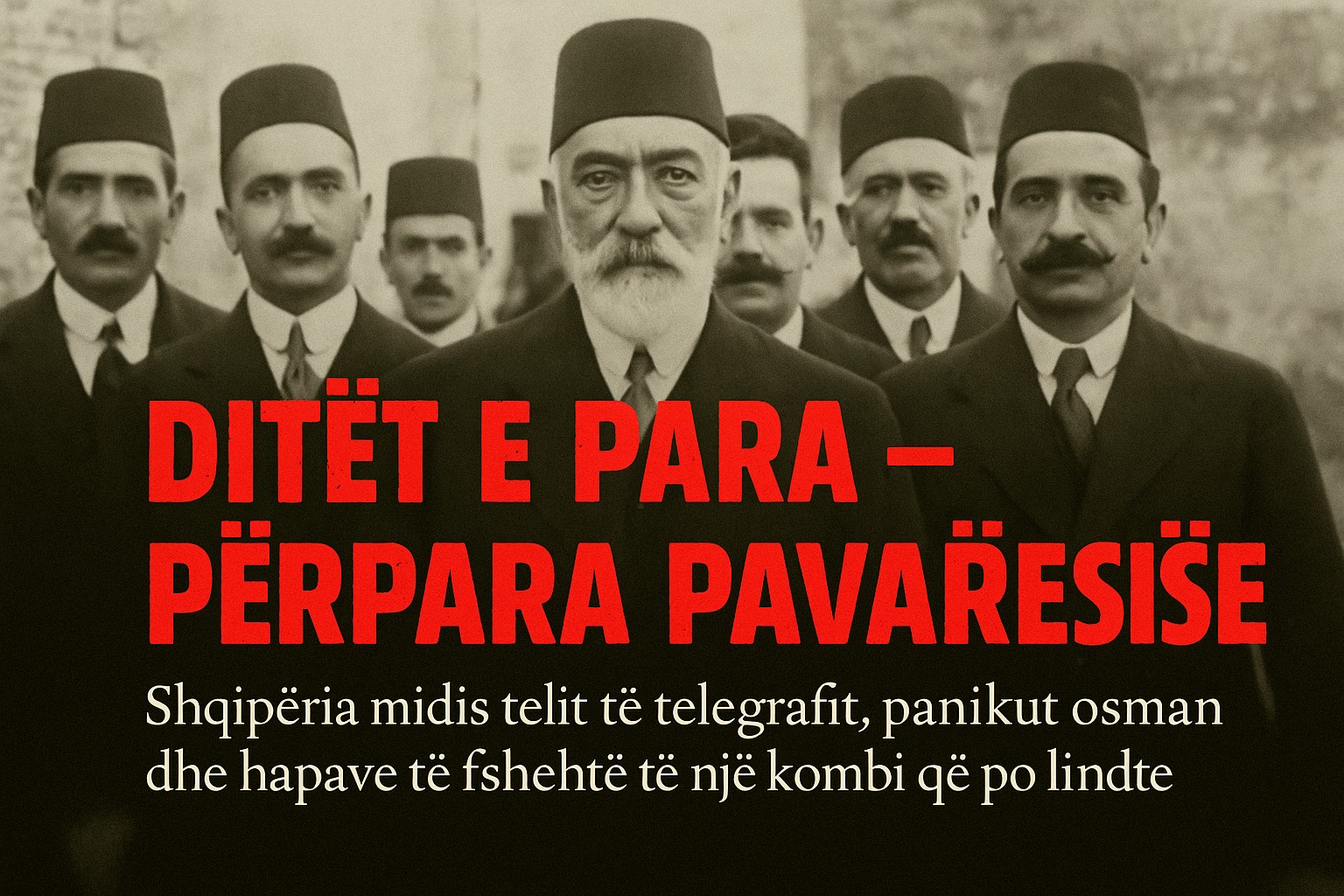
English editorial adaptation of Historiani’s Albanian article. The source page contains dates, direct quotations and interpretations of coded messages that require comparison with the original telegrams. This test edition summarises its central themes without treating those disputed details as established facts.
Communication before independence
In the weeks surrounding Albania’s declaration of independence in November 1912, telegrams connected political figures, local notables and administrative offices across a territory affected by the Balkan Wars and the weakening of Ottoman authority.
Historiani’s Albanian article explores this correspondence as evidence of two overlapping processes: attempts by Ottoman officials to preserve order, and efforts by Albanian organisers to coordinate delegates and political action.
Ottoman instructions on order and unity
The source article describes Ottoman circulars calling for unity, the prevention of disturbances and obedience to administrative authority. Such instructions reveal the concerns of officials trying to retain control during a rapidly changing situation.
They must also be interpreted carefully. A reference to unrest does not, by itself, prove that a document was explicitly discussing independence. Establishing the intended meaning requires the original wording, the sender, the recipient and the surrounding correspondence.
Ismail Qemali and the organisation of delegates
The article links the telegram network to Ismail Qemali and his collaborators, describing communications among towns including Durrës, Elbasan, Korça, Ohrid and other centres. Its main theme is practical coordination: informing local leaders, choosing delegates, arranging travel and maintaining public administration.
Seen in this way, the telegrams concern more than prominent political declarations. They also record the organisational work required before a national assembly could meet.
Messages, routes and chronological questions
The Albanian narrative gives a sequence of journeys and telegrams, and interprets one message about a sick person as political code. Those conclusions need documentary verification. In particular, the dates attributed to Ismail Qemali’s movements and arrival in Durrës should be checked against the original telegrams and a reliable chronology.
This English edition does not reproduce the source page’s exact-date claims or direct speech as verified quotations. A defensible reconstruction should distinguish the date of a telegram, the event it reports, and the later interpretation placed on it.
The archival file as a research starting point
The source article identifies a file concerning notices and instructions about the activities of Ismail Qemali and his collaborators, inside and outside the country, in preparing the election of delegates and the meeting of the First National Assembly.
A complete English study would need a full archival reference, the individual telegram dates, faithful transcriptions and clear identification of senders and recipients. These would allow the correspondence to be arranged chronologically and interpretations to be tested.
Why these communications matter
The value of such material lies in showing political organisation at work. Messages moving between towns can illuminate the relationship between central leadership and local initiative, the persistence of administrative routines, and the uncertainty experienced by people making decisions before the outcome was known.
The telegram network offers a way to study the preparation for independence through concrete exchanges rather than retrospective legend. That potential makes careful transcription and source attribution essential.
Source: Historiani’s Albanian article on telegrams and the preparation for independence in 1912. The displayed page does not provide the full archival shelfmark. Prepared for review on the test site.