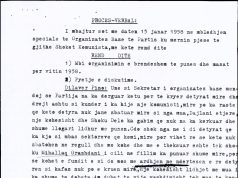
In 1964, the Basic Party Organization at a military unit faced a difficult decision: should Kujtim Xhelili, a correct and educated soldier, but with a dubious political past due to his fugitive brother, be accepted into the Party? His file is a rare document that reveals how a person was judged in the totalitarian system not only for his deeds, but also for his thoughts and family ties.
“He was a supporter of the fugitive brother” – The suspicion that stopped everything
On the first page of the document, the Party cell states:
“He stated that in 1951, his brother fled from Albania. At that time, Kujtim maintained a positive attitude towards the escape, saying: ‘It was good that he fled.’ Only later did he change his attitude, saying that it was not right.”
This statement was the foundation of the entire debate. Although Xhelili had self-criticized, apologized, and emphasized that “I didn’t understand much politics back then,” many members of the organization were not convinced of his sincerity.
Positive reviews weren’t enough
Part of the organization assessed him favourably:
- “He has average culture, is interested in political work”
- “He has participated in various activities, with good attitude in the department”
- “He was involved in the Youth organization”
But immediately after them, came the contradictions:
“When he has self-criticized, he has not shown deep remorse for his previous stance.”
“He has not openly campaigned to condemn his brother’s escape.”
“There has been a reluctance to speak about this issue clearly and directly.”
Kujtim’s Replies: “I experienced it badly”
In his defense, Kujtim wrote:
“I was wrong when I said then that my brother did well to leave. It was a narrow, unformed opinion. Over the years and thanks to the Party’s education, I have come to understand that it was a hostile act. I was honest in my self-criticism.”
He had asked not to be judged for what he had been in his youth, but for what he was today.
A postponed, not final decision
In conclusion, the Basic Organization, after considering the pros and cons, decided:
“At the moment, Kujtim Xhelili is not being accepted into the Party. He should be continuously followed by the organization. He should be assigned tasks and his ideological clarity should be seen in practice.”
This was not an exception, but a postponement in time – a test of loyalty and real change.
A supervised life – the Party’s lesson for all
The Kujtim Xhelili dossier is more than a debate about membership. It is a clear picture of a system where:
- A thought spoken in 1951 could affect someone’s career in 1964.
- A runaway brother can become an obstacle to a loyal soldier’s political destiny.
- Self-criticism had to be deep, felt, and sincere – otherwise it was not considered valid.
- The party did not accept those who said “I understood late”, but those who showed conviction with actions.
Why is this file important today?
Because it reminds us of how the political selection mechanism really worked in the dictatorship. Decisions were not made solely through work, but through the analysis of conviction and loyalty. And this dossier is an invitation to better understand how a society functioned where every thought had consequences.