Albania was a fragmented and endangered country. For four centuries, Albanians had lived under the rule of the Ottoman Empire, but the spirit of the National Renaissance was strengthening a new desire: national liberation and unification into a single Albanian state . After decades of uprisings, petitions, memoranda and battles in the international arena, the year 1912 would bring a historic event that would change the fate of the Albanian nation.
Uprisings and the alarm for the division of Albanian lands
The Albanian uprisings of 1908–1912, especially that of 1912 , brought a great shock to the Ottoman administration. The Albanians demanded administrative autonomy, recognition of the Albanian language in schools and administration, and the unification of the Albanian vilayets . In 1912, Albanian troops reached Skopje, forcing the Ottoman government to accept a series of demands.
But, in the meantime, the First Balkan War broke out and the armies of Serbia, Montenegro, Greece, and Bulgaria marched to divide the Albanian lands, without considering the existence of a separate nation.
Then, the Albanians had to act immediately . It was understood that only a clear and coordinated act – the declaration of independence – could save the Albanian lands from division.
Call for Assembly in Vlora
In early November 1912, Ismail Qemali , a figure of the Albanian National Awakening and an experienced politician with experience in Istanbul and Europe, returned from Bucharest to Albania. On November 21, 1912, he arrived in Durrës and then in Vlorë. It was time to convene an assembly representing all Albanian territories , from North to South, to decide the fate of the country.
The call spread rapidly throughout the four Albanian vilayets: Shkodra, Kosovo, Manastir and Ioannina. Representatives from various cities, such as Shkodra, Prizren, Peja, Gjakova, Tetovo, Dibra, Struga, Elbasan, Berat, Gjirokastra, Ioannina, Çamëria, etc., made their way to Vlora. Albanians from the diaspora – Bucharest, Istanbul, Sofia, Egypt – were also represented.
November 28, 1912 – The Great Historical Act
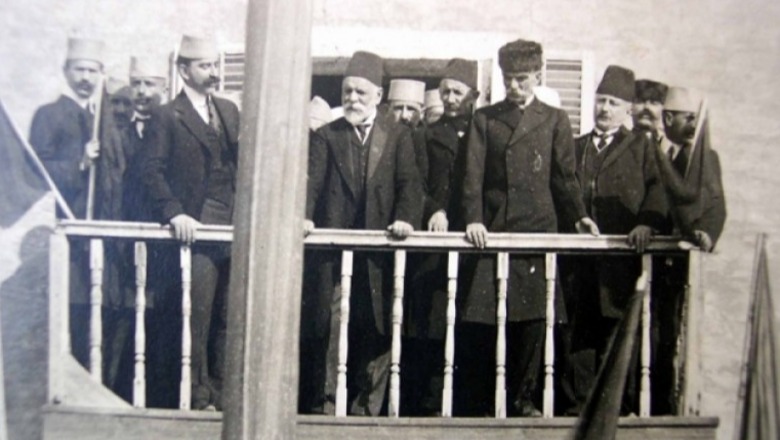
On the morning of November 28, 40 delegates from all Albanian regions gathered at the house of Xhemil Bey in Vlora . The assembly, led by Ismail Qemali, discussed the critical situation and ultimately adopted a historic act:
“We declare Albania free and independent from any foreign occupation.”
After this declaration, on the balcony of the building , Ismail Qemali, together with Luigj Gurakuqi , raised the red and black flag with the double-headed eagle , at noon on November 28, 1912.
A powerful voice emanated from the crowd:
“Long live independent Albania!”
Signers of the Act of Independence
Among the signatories of the act were names representing all regions and faiths:
- Ismail Qemali (Vlora)
- Luigj Gurakuqi (Shkodra)
- Dom Nikoll Kaçorri (Durres)
- Bajram Curri (Tropojë)
- Isa Boletini (Mitrovica)
- Mustafa Kruja (Kruja)
- Qemal Karaosmani (Elbasan)
- Baba Duda Karbunara (Berat)
- Abdi Toptani (Tirana)
- Rexhep Mitrovica (Kosovo)
- Vehbi Dibra (Greater Dibra)
- Mufti Vehbi Agolli (Kukës)
- Jani Minga (Fier)
- Nebi Sefa (Lushnjë)
- Pandeli Cale (Korca)
and many others.
The First Government of Albania
After the declaration of independence, the assembly elected a provisional government , with Prime Minister Ismail Qemali and Vice President Dom Nikoll Kaçorri . It was decided that the official language would be Albanian , the first diplomatic missions were established, and the organization of the administration of the new state began.
The Legacy of November 28
The act of November 28, 1912 was not just a symbolic act. It gave Albania a state identity , which would face great challenges – international conferences, wars, fragmentation of lands – but also the strength to survive as a nation united in language, culture and history .