In the years 1595–1596, the Holy See maintained continuous ties with the Albanian territories through the apostolic nuncio in Venice , Monsignor Timoteo Graziani , Bishop of Amelia.
In the reports he sent to Cardinal Saint George in Rome, the dioceses of Klish, Shkodra, and Pulti are often mentioned as centers with ancient religious tradition, but which at that time were in a difficult situation under the rule of the Ottoman Empire.
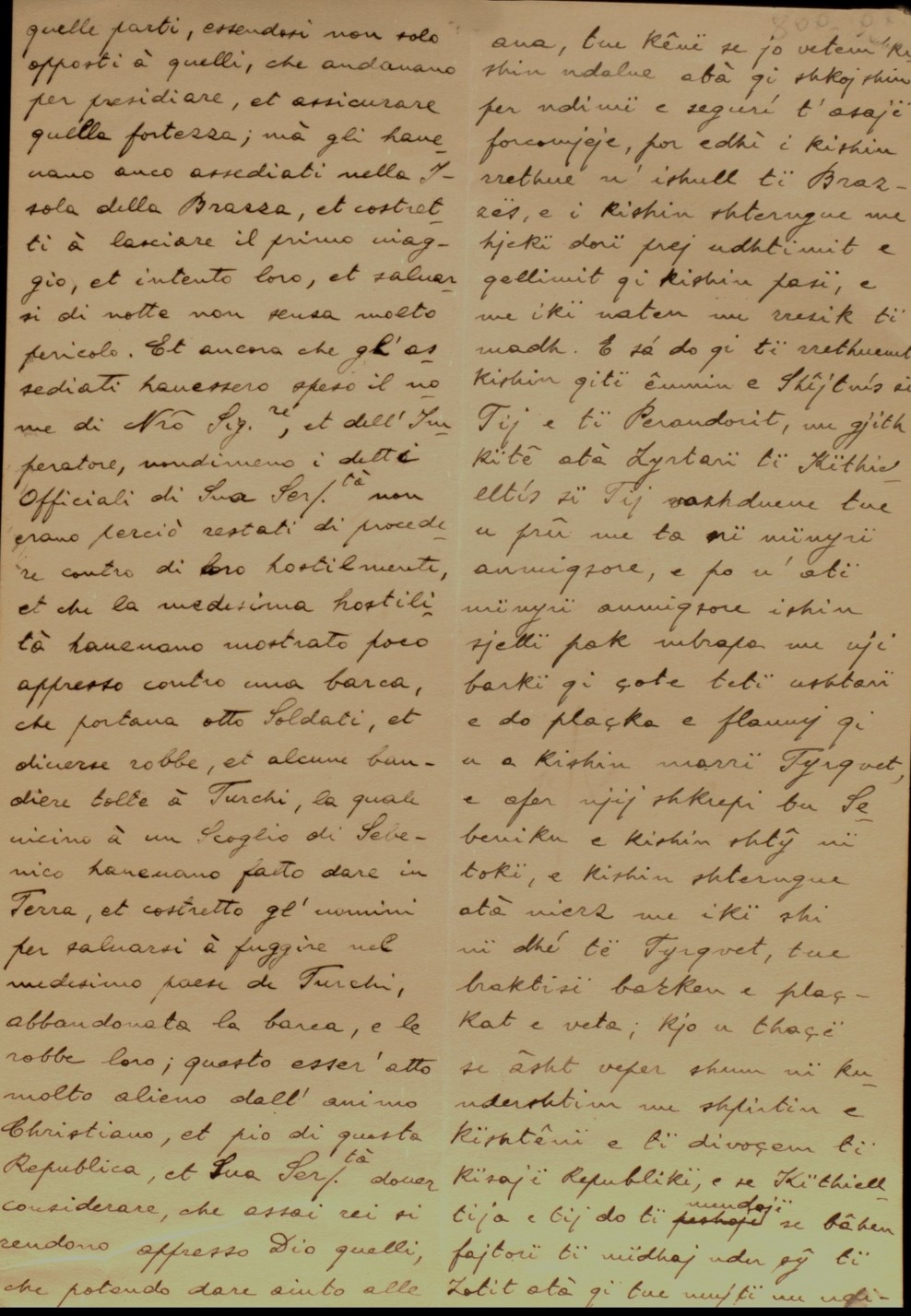
One of the pages of the original manuscript bears the title:
“PROTOCOL OF LETTERS OF MONSIGNOR GRAZIANI, BISHOP OF AMELIA, NUNCIO IN VENICE, WRITTEN TO THE CARDINAL OF SAINT GEORGE, UNDER POPE CLEMENT VIII, FROM 24 MARCH 1596 TO 28 DECEMBER 1596.”
This protocol contains letters and reports that describe in detail the reality of the Albanian churches: priests who served secretly, bishops who sought financial assistance from Venice, and efforts to keep religious tradition alive in a land where the Catholic faith was under constant oppression.
Klish – an ancient center of religious resistance
In Graziani’s reports, Klish (Clissi) , a small diocese but of great spiritual importance, is often mentioned.
According to Valentini’s extracts, in this area the priests lacked liturgical books and sacraments , while communication with the bishop was done through couriers passing through from Tivar or Lezha.
One of the most readable passages states:
“…in Klish, the priests are few and they have no regular masses or celebrations; the people are kept in the faith with great difficulty and are often helped by priests who come from Shkodra.”
This indicates a vibrant but fragile situation: the local clergy maintained the faith in extraordinary conditions, often without an official structure.
The nuncature of Venice itself intervened to send aid in kind or to include them in the Vatican’s aid lists for the “Eastern missions”.
Shkodra – the spiritual capital of the north
In the 1596 document , “Scodra” is mentioned several times as the most important center of the Catholic faith in Albania.
One fragment states that “the bishop of Shkodra could not remain in his see due to pressure from the Ottoman rulers,” and that the main church was half-ruined , but the faithful kept the tradition alive with secret masses in private homes .
A passage preserved in damaged form reads:
“…in the city of Shkodra the people are numerous in faith, but the clergy are scattered; part of the bishopric remains in the surrounding villages to avoid persecution. Those who remain in the city perform the services of the Lord in silence.”
This description, close to the reality of the time, shows the contrast between the spiritual strength of the community and the material and political difficulties that surrounded it.
Pult and the network of Albanian dioceses
In the same “Register of Letters”, Graziani also mentions the diocese of Pult (Pulatum) and its connections with Shkodra.
Reports speak of a communication network that connected Albanian priests with bishops in Dalmatia and Tivar (Bar), secretly crossing Ottoman borders.
According to a note that Valentini translated into Albanian:
“News are regularly sent from Pulat about the condition of the people; they are steadfast in their religion, but they need help to rebuild the church of St. John.”
This indicates a stable internal organization , which survived even though official structures were severely damaged.
The message of Graziani’s letters
What is clear from these sources is that:
- The Albanian Church of the 16th century was not extinct, but hidden.
- Albanian priests and bishops had a missionary consciousness and sought cooperation with Venice and the Vatican.
- The apostolic nuncature served as a diplomatic and spiritual node that protected the religious interests of Albanians in the Adriatic.
Zef Valentini, by summarizing these documents, managed to reconstruct a vivid picture of Albanian Catholic life at the end of the 16th century — a picture that shows a people who maintained their faith, even when the church was without a cathedral and without official freedom.
Conclusion
The second article in the series is dedicated to this “spiritual map” of 1596, where Klish, Shkodra, and Pulti appear as bright spots of religious resistance.
Through the work of Monsignor Graziani and the dedication of Valentini, these testimonies reach us today — as a reminder of the strong roots of faith and culture in Albanian lands.
“From Klish to Shkodra, from Pulti to Tivar, the light of religion never went out; it was kept burning by those who, even under the shadow of Ottoman power, never forgot their God.”