TIRANA – December 1976
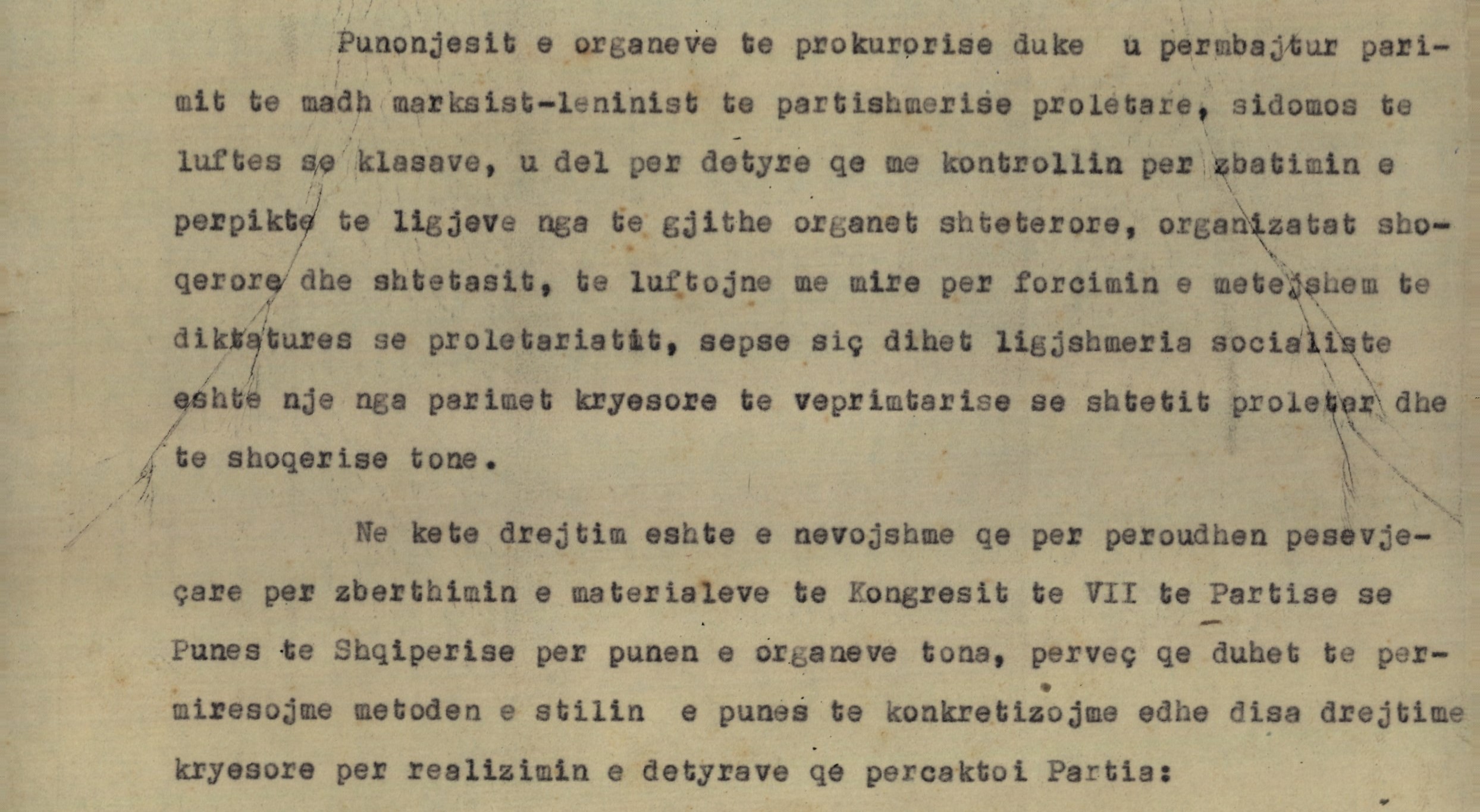
In a secret document titled “Tasks of the prosecution bodies for deepening control over legality” , signed by Deputy Prosecutor General Sotir Samara , it is revealed how the Albanian prosecution was not simply a legal body, but a political instrument of the Party of Labour of Albania , in service of the Marxist-Leninist line of leader Enver Hoxha.
What does the document contain?
The document, divided into several sections, gives direct orders to:
- Strengthening the role of the Party in the work of prosecutors;
- Revolutionizing the prosecution apparatus;
- The fight against “bureaucratism, technocracy and liberalism”;
- Designating specific sectors for in-depth control;
- Activation of people’s prosecutors in villages and cities;
- The meticulous implementation of Comrade Enver’s orders .
⚖️ “The law is the weapon of the dictatorship of the proletariat”
The introductory part clearly states:
“Employees of the prosecution bodies must strictly implement the Party’s directives, the teachings of Comrade Enver, and the decisions of the grassroots organization.”
So, justice does not stem from a constitutional principle, but from the directives of the Party of Labour of Albania . The law is not seen as neutral, but as a tool to wage class struggle and protect the construction of socialism .
🔍 Ruthless investigation of the enemy
The document orders that:
“Strengthen control over investigations into crimes against the state, socialist property, and all cases that are brought to trial.”
Prosecutors are advised not to leave any guilty party unpunished , but equally dangerous are violations by investigators or the administration that negatively affect trust in “socialist legality.”
👥 Activation of “people’s prosecutors”
An interesting element is the engagement of citizens as “people’s prosecutors” to oversee the implementation of the law in neighborhoods, villages, or enterprises:
“People’s Prosecutors should monitor compliance with the law and be accountable to the Prosecution Collegium.”
They were to report, distribute legal literature, attend trials, and propagate among the people for education according to socialist norms.
🏗️ Sectors in focus: from oil to the countryside
The document notes for the first time the sectors where the Party demanded rigorous control :
- Administration of grains and agricultural land;
- Capital construction and the oil industry;
- Investigating violations in re-education camps and prisons;
- Military Prosecution: law enforcement in the Army, mobilization, training and combat readiness.
📚 Legal education with “the lessons of comrade Enver”
The document ordered all prosecutor’s office employees to:
“To have their own individual plan for ideological and technical-professional preparation.”
The publication of an internal bulletin with political orientations , as well as the development of joint seminars with the Ministry of Internal Affairs and the Supreme Court , were part of the plan for the revolutionary education of lawyers.
👂 Justice had to be accountable to the people
One of the most interesting elements of this document is the idea of popular control over the prosecution :
“No prosecutor’s office employee should be left outside the scrutiny of the masses. They should be systematically held accountable before the people.”
This was a symbolic form of civic participation, but in reality it reinforced the Party’s ideology as above all else, including justice.
🧭 Conclusion: Justice for the Party, not for the citizen
This document, which was not intended for the public, reveals in detail the depth to which the judicial system was captured by political power . The prosecution is not seen as a neutral institution, but as an obedient soldier of the dictatorship of the proletariat , which was supposed to:
- He carried out Enver Hoxha’s instructions;
- He controlled the state, the citizen, and himself;
- It educated society through fear and ideological persuasion.