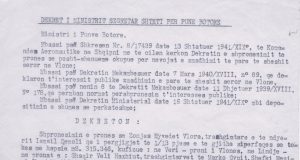
In October 1980, the General Prosecutor’s Office sent an official proposal to the State Social Insurance Directorate to fill a discriminatory legal gap: although the blind, deaf-mute and disabled were entitled to a special old-age pension in the city, this right was not recognized at all for members of agricultural cooperatives in the countryside. This inequality, officially documented, sheds light on the shortcomings of the legislation of the time and the unequal treatment of citizens under the dictatorship.
What did the existing law say about citizens in the city?
According to Law No. 4171, dated 15.9.1966 “On State Social Insurance”, Article 19 stipulated that:
“The blind, the deaf-mute and those who were in conditions of disability of groups I and II before entering work, receive an old-age pension when they reach the age of:
- men aged 50 with 15 years of work experience,
- “40-year-old women with 10 years of work experience.”
So, these people were entitled to a special old-age pension, at an earlier age and with more relaxed conditions , but only if they were employees in the urban state sector .
But for the cooperative farmers? Total silence.
Law No. 4976, dated 29.6.1972, “On pensions of members of agricultural cooperatives”, did not contain any provision for this category . So, if a blind or deaf-mute person lived and worked in the village as a member of the cooperative, he did not benefit from this legal exemption .
The General Prosecutor’s Office’s proposal: equality for all
In the letter dated October 7, 1980, signed by Deputy Prosecutor General Abaz Brati , he officially addressed the State Social Security Directorate in Tirana with this suggestion:
“We think that there is room for additions to Law No. 4976, dated 29.6.1972, for the blind, deaf-mute, etc., so that they benefit equally as those in the city.”
This proposal was also based on preliminary conclusions shared with colleagues in the relevant directorate , which indicates that the problem was known, but not yet addressed by legislation.
A clear example of systemic inequality in dictatorship
The document proves that even in a system that claimed “total equality”, there were numerous excluded categories – not through their own fault, but because they were covered by a different pension scheme.
In reality, a blind citizen in the city was treated differently than a blind citizen in the countryside.
Archival reference: Fund 492, File 193, Year 1980 – Proposal of the General Prosecutor’s Office for the inclusion of special categories of cooperative members in state social security benefits.