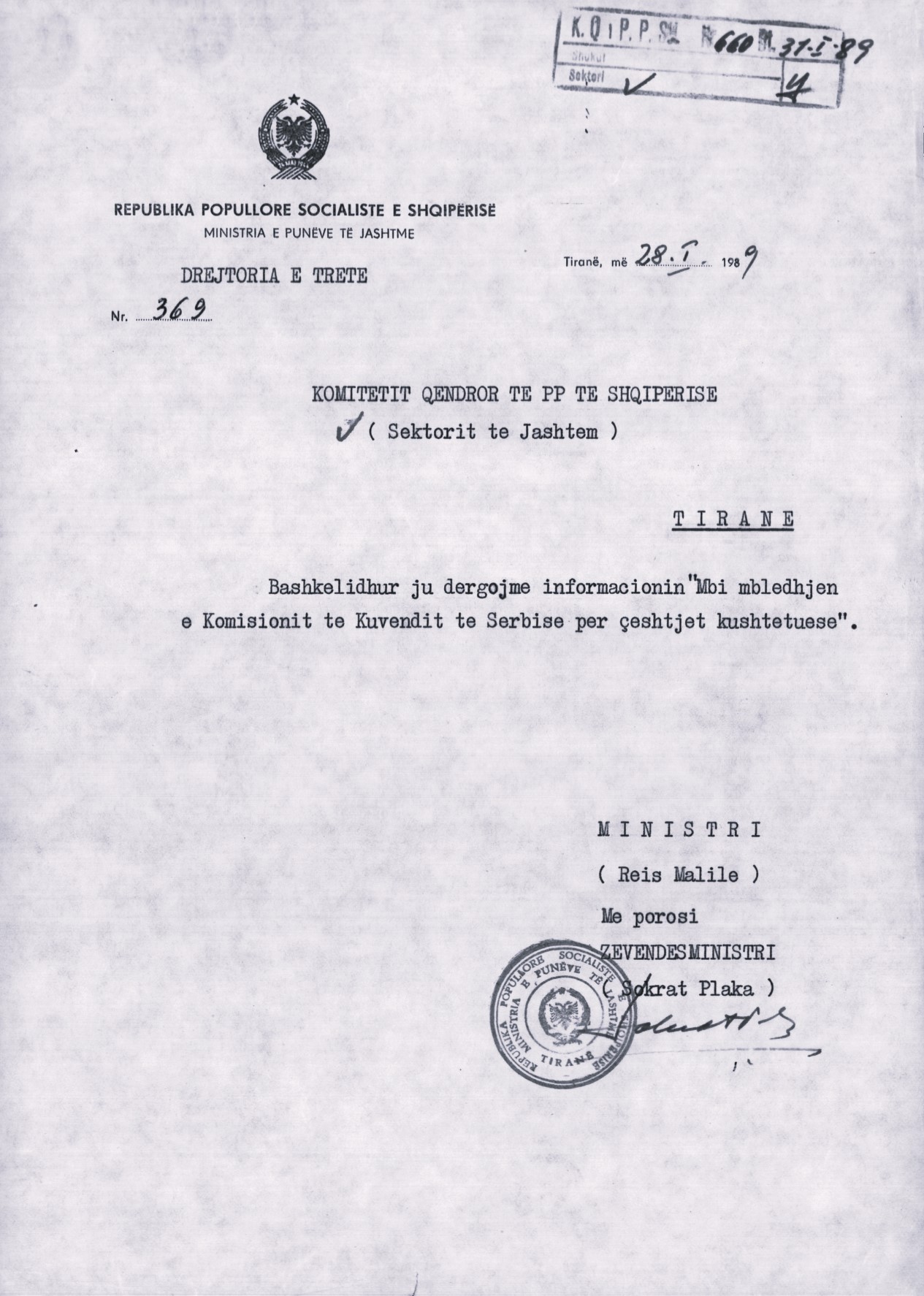
In January 1989, when tensions in Kosovo were increasing day by day, a secret document from the Albanian Ministry of Foreign Affairs for the Central Committee of the Party of Labour of Albania reported in detail on the meeting of the Serbian Parliament’s Committee on Constitutional Affairs .
This material, classified at the time as “for internal use only”, accurately describes the process that marked the beginning of the end of Kosovo’s autonomy , through the changes that Serbia sought to make to its Constitution.
Against linguistic and national equality
According to the document, on 6–7 January 1989 , the Commission discussed and approved, with only one vote against (Kosovo representative Syrja Popovci), the draft constitutional amendments of Serbia . The text adopted by the Serbs renounced any guarantee of equality between nations and nationalities, essentially declaring the dominance of the Serbo-Croatian language throughout the territory of the republic.
The document states:
“In the Socialist Republic of Serbia, the Serbo-Croatian language and the Cyrillic and Latin alphabets are in public and official use… In areas where separate nationalities live, the Serbo-Croatian language and other languages of those nationalities are in equal official and public use, in accordance with the Constitution and the law.”
In the previous version of the project, Kosovo and Vojvodina had guaranteed the use of national languages “in the regions where certain nationalities live.” But, with the new amendment, this was completely abolished , giving absolute priority to the Serbo-Croatian language as the “unifying” language of the Serbian state.
A planned movement against autonomy
The Serbs, according to the Tirana report, justified the removal of the paragraphs on linguistic equality on the grounds that they were “in contradiction with the Constitution of the SFRY”, although in reality they intended to limit the official use of Albanian and Hungarian in Kosovo and Vojvodina.
The text clearly states:
“The new formulation of the Serbs argues that Serbia is a unitary state, despite the fact that in its composition there are two autonomous units… The Constitution of Serbia is the supreme legal act, therefore all other legal acts on its territory have weaker legal force.”
This change marked the erasure of Serbia’s federal character , placing Kosovo in a position of complete subordination to Belgrade.
Limitation of Kosovo’s competences
The Albanian Ministry’s document lists the amendments that Serbia had prepared:
- Amendment 30 – determined that only republican (Serbian) bodies would be responsible for implementing laws throughout the territory of the republic, including the provinces;
- Amendment 32 – gave Serbia the sole right to regulate the use of state symbols and the system of national defense;
- Amendment 36 – prohibited the provinces from engaging in international cooperation without Belgrade’s approval;
- Amendment 44 – gave the Supreme Court of Serbia the authority to decide on provincial issues;
- Amendment 46 – stipulated that the Constitution of Serbia could be amended without the consensus of the provinces, only with a 2/3 vote of the Assembly of Serbia .
The report categorically states that this abolished the principle of constitutional equality of the provinces, reducing them to mere “administrative units”.
Kosovo was left alone.
At the end of the report, the author emphasizes that during the discussions, Kosovo remained isolated : representatives of Vojvodina fully supported Serbian positions, while members of the Kosovo Constitutional Commission opposed them.
According to the document:
“The remarks of the Constitutional Commission of Kosovo were not accepted. This has raised great concern among Kosovars, who have sent letters to the highest bodies of the Federation. Azem Vllasi requested a meeting of the Kosovo Provincial Committee on January 7 to discuss the harmonization of issues for constitutional amendments.”
Meanwhile, journalists from “Rilindja” and Albanian intellectuals in Kosovo openly criticized Serbian chauvinism , warning that any such change would be a “violation of federal agreements.”
A comment by Rustem Rugova , quoted in the document, underlines:
“The Constitution cannot be amended through an unconstitutional procedure.”
In Kosovo, numerous protest meetings were held, where ordinary Albanian people and intellectuals openly denounced the “anti-Albanian actions and attitudes of Serbs.”
The Albanian members of the Kosovo Constitutional Commission, Iliaz Kurteshi and Syrja Popovci , were publicly defended by Albanian opinion, although the Serbs demanded their criminal prosecution .
The Albanian reaction and Tirana’s stance
At the conclusion of the report, the Albanian Foreign Ministry suggested that an information and solidarity campaign be carried out in the Albanian press with the people of Kosovo .
The document states:
“We are thinking of writing an article in the newspaper ‘Zëri i Popullit’ condemning the anti-Albanian chauvinist actions of Serbs to narrow Kosovo’s autonomy. Also, ATSH should give biased reports received from Tanjug regarding this problem.”
Finally, the report concludes with the warning that any Serbian action would encounter strong resistance from the Albanian population , and that “Kosovo’s leadership cannot act against the will of the masses.”
Briefing
This 1989 archival document, sent by Foreign Minister Reis Malile and signed by Deputy Minister Sokrat Plaka , is clear evidence of Serbia’s efforts to silently undo Kosovo’s autonomy , starting with language restrictions and constitutional competencies.
Just a few months later, in March 1989, the Serbian amendments were approved , and a dark period began for the Albanians of Kosovo – what history knows today as the beginning of the suppression of autonomy and the precursor to the dissolution of Yugoslavia.