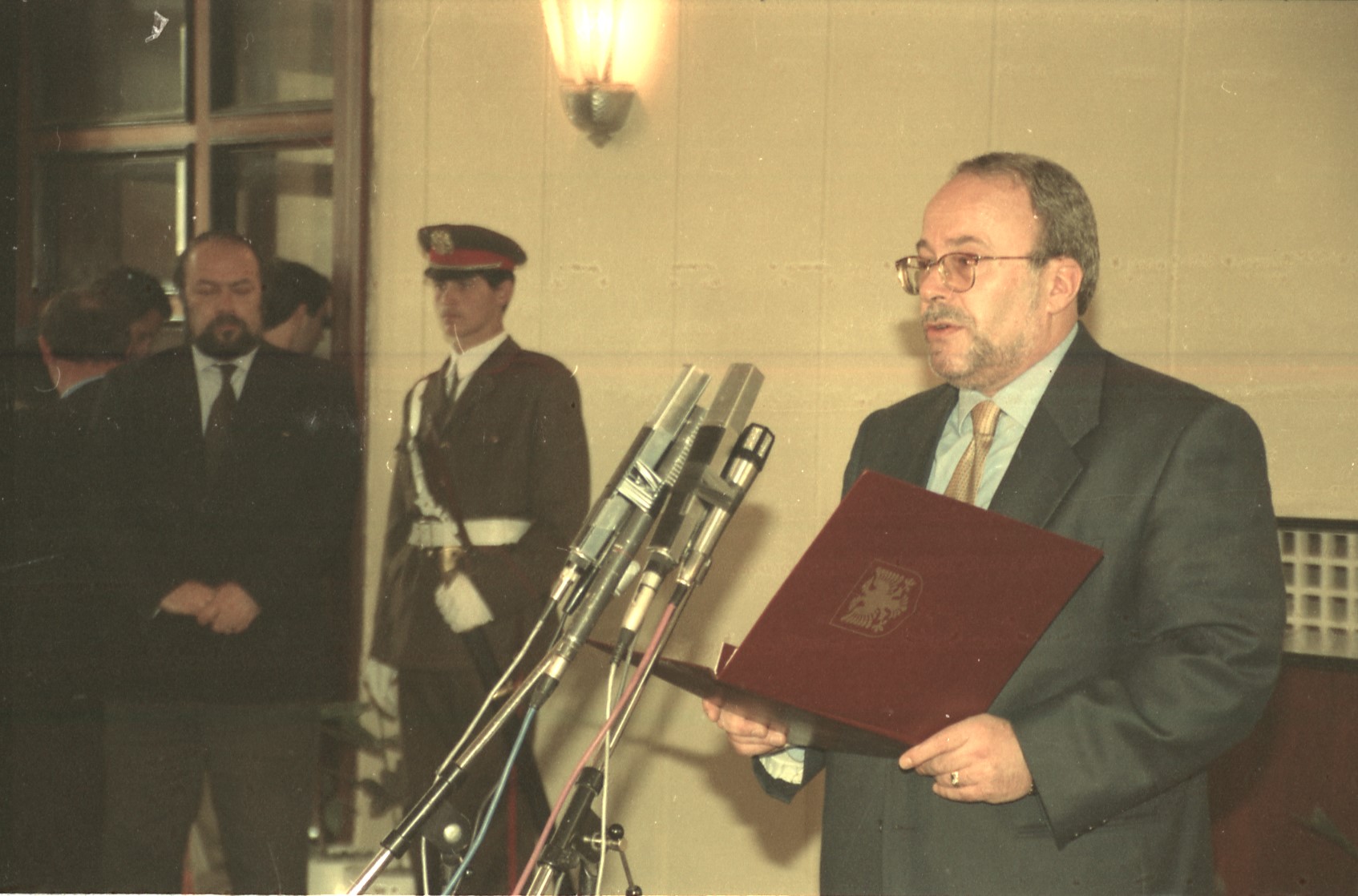
Fatos Nano’s historic speech in December 1990 marked the beginning of the end of the socialist system in Albania. A clear analysis of the market economy, self-financing, and political transformation that brought about great change.
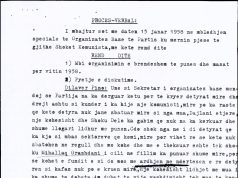
At the end of December 1990, when the political turmoil of Eastern Europe had reached every corner of Albania, the national assembly was held in the closed halls of the Party of Labour of Albania, a meeting that would go down in history as one of the last moments of the socialist system.
At that table, alongside Ramiz Alia, Fatos Nano took the floor, a name that would later mark the beginning of a new political era in the country.
“The vitality and renewing force of the Party”
Nano began his speech with an institutional tone, praising Ramiz Alia’s leadership and calling the Party’s electoral program “proof of its vitality and regenerative force.”
But after this introduction, his speech took a different direction — a quiet but profound self-criticism of old methods of economic governance.
“The continuation of overly centralized management and administrative methods of the economy for a long period has curtailed the initiative of the masses…”
With this sentence, Nano gave voice to a reality that was known within the PPSH, but rarely articulated publicly: the planned economy was running out , and the spirit of the free market had to enter .
From artificial equality to encouraging private initiative
At a time when the very mention of “private property” was taboo, Nano openly emphasized that different forms of ownership needed to coexist : state, cooperative, and private.
According to him, the state should take on the role of a regulator , not an indiscriminate financier of every enterprise.
“The resources that the state will provide through tax and price policy will no longer be used to finance everything, but only to support the economic strategy.”
Essentially, this was the first public signal of the transition to a market economy — a concept that until then was considered “bourgeois.”
Against monopoly and centralization
Fatos Nano also criticized large industrial and agricultural concentrations, calling them obstacles to the development of competition and the promotion of the internal market.
“Enterprises with over 500 employees provide 86 percent of production… but this rigid structure has made people passive consumers.”
Essentially, he called for the dissolution of state monopolies and the creation of small and medium-sized enterprises , which would revitalize the market and employment.
Market, prices and reality
In another significant passage, Nano emphasized that planning without a market could no longer function , and that prices, wages, and the exchange rate had to reflect economic reality.
“Planning cannot be realistic if prices, wages and taxes are kept frozen for long periods of time, regardless of the dynamics of the economy.”
These words – spoken inside a communist party hall – sounded like a manifesto of future reforms .
From isolation to European integration
In the final part of the speech, Nano spoke about cooperation with foreign capital and Albania’s involvement in European integration processes , a completely unprecedented topic for an PPSH forum.
“We have numerous points of contact for joint activities with foreign capital… for the country’s involvement in the European integration process.”
These words, in the cold December of 1990, were a clear sign that the old era was ending , and that even in the highest structures of the party , an awareness of change had arisen.
A speech that warned of the future
In retrospect, this speech by Fatos Nano, then a young economist with reformist leanings, can be seen as the intermediate moment between the PPSH and the Socialist Party of Albania .
He spoke with the language of a party that wanted to save itself by changing itself , at a time when the system was already collapsing.
In December 1990, in a country that was beginning to awaken from fear, Nano articulated the idea that would later translate into political reality:
Albania had to embark on the path of economic, democratic and European reforms.