“The causes of the defeat of the Democratic War in Greece and the mistakes of its leadership”
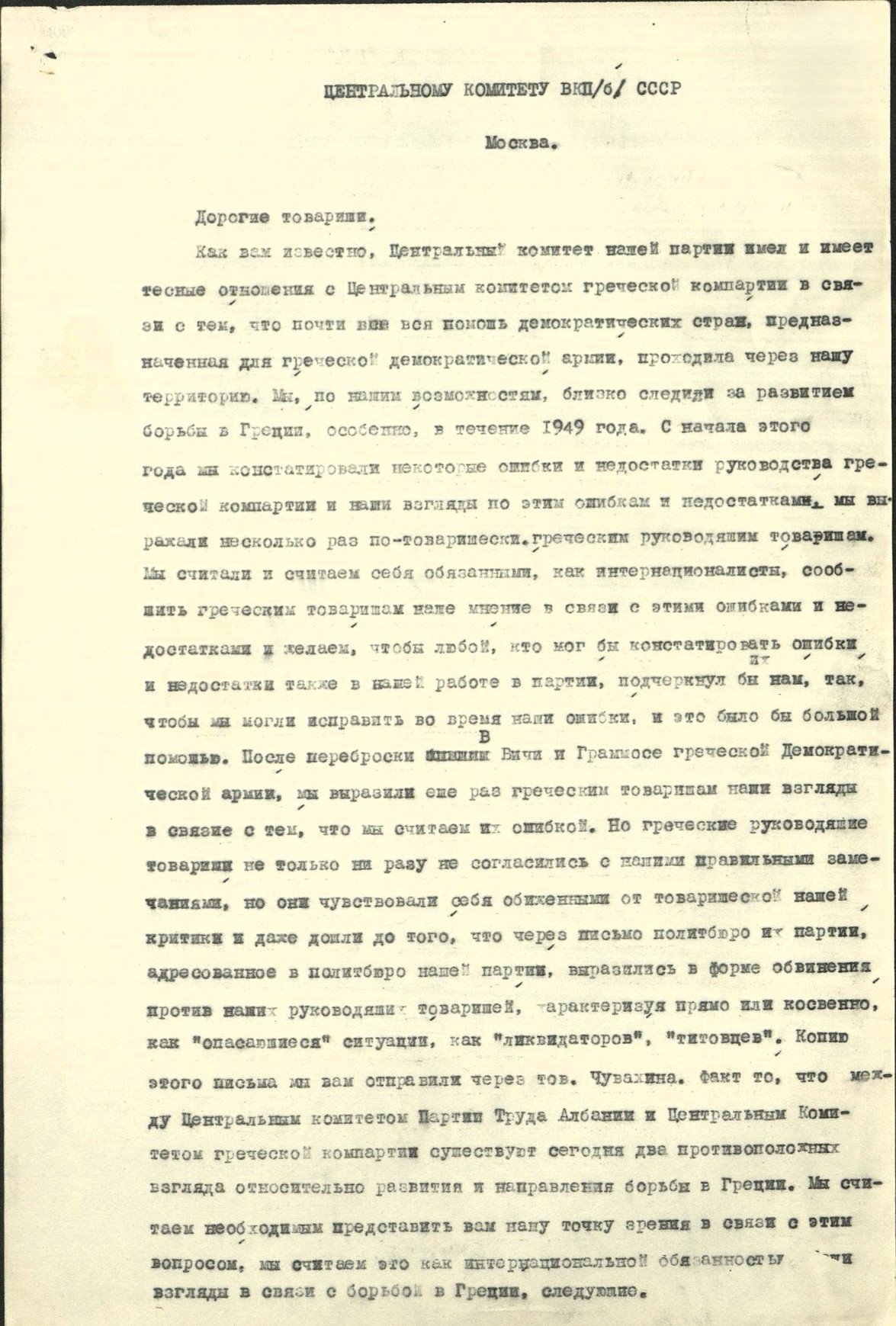
In the late summer of 1949, as the flames of the Greek Civil War were dying down, Enver Hoxha sent a long and harsh letter to Moscow — a document that remained secret for decades.
In it, he presents a complete analysis of the causes of the defeat of the Greek Democratic Army and the failure of the revolution that had shaken the Balkans for three years.
The letter, sent through Soviet ambassador Chuvakhin, was a direct ideological criticism of the Central Committee of the Communist Party of Greece and a political message to Stalin on Albania’s position in this crisis.
Part of the letter
“As you know, the Central Committee of our Party has maintained the closest and most fraternal relations with the Central Committee of the Communist Party of Greece.
Almost all aid from democratic countries to the Hellenic Democratic Army has passed through our territory.
“We did everything to help the development of the war in Greece during 1949.”
Hoxha then strongly asserts that the defeat was not inevitable , but a consequence of the ideological and military mistakes of the Greek leaders .
“The leadership of the Greek comrades has often acted with sectarianism, narrow-mindedness and a lack of internationalism. They have not known how to accept criticism and have reacted with hostility to any remark.”
Analytical comment
Here Hoxha displays his typical Stalinist style — an analysis based on the “lessons of Lenin and Stalin,” where every failure is explained away as an ideological deviation. He seeks to show that Albania had been more consistent than communist Greece itself in following the correct revolutionary line.
Continuation of the letter
“In the leadership of the Democratic Army of Greece, the same tendencies continued to prevail. Instead of proletarian elements, old career officers and conservative peasants were elevated to positions of responsibility.
… They did not understand that a partisan army is the very soul of the people. By turning it into a ‘regular’ army, they cut it off from the masses.”
Hoxha emphasizes that the fundamental mistake was abandoning partisan warfare and trying to turn it into regular conventional warfare, a “harmful illusion” that led to disaster.
Short comment
At this point, the tone of the letter becomes almost accusatory. Albania is presented as the “ideological teacher” of the Greek communists, who had followed the wrong example of Tito and had forgotten the Leninist principle: the people’s army is born from the people and remains with them .
Later part
“The commander and the political commissar must be a single authority.”
In the Greek army, after the death of Markos, this connection was severed.
“This was a grave mistake. A people’s army without political leadership loses its revolutionary spirit.”
This passage is typical of the way Hoxha constructed his arguments: he did not limit himself to military analysis, but sought to emphasize the role of the party over the army — a concept that was essentially the project of his own political system in Albania .
The Fall of Vitsi–Gramos
“The partisan forces were holed up in the Vits and Gramos mountains…
They fought bravely, but without clear revolutionary direction.
The leadership accepted the idea of a frontal war against a much stronger enemy.
The monarcho-fascist powers destroyed them, and the democratic army retreated to Albanian territory.”
Hoxha’s analysis of the defeat
“This defeat was not only military, but political.
The Communist Party of Greece failed to understand that permanent defense is the grave of the revolution.”
In this section, Hoxha links the Greek failure to Engels’ teachings on the war in the mountains, citing him as a theoretical authority. He builds a bridge between the classics of Marxism and the Balkan experience, to prove that Albania had implemented the principles of the revolution better than the Greeks themselves .
Closing the letter
“We hope that Greek comrades will seriously analyze these criticisms, correct the mistakes, and understand that only self-criticism and ideological clarity can avoid new defeats.”
The revolutionary war in Greece is not over.
It can be revived if led with patience, perseverance and popular spirit.”
Finally, Hoxha concludes with a greeting to the Central Committee of the Communist Party of the Soviet Union and “the great comrade Stalin “, underlining Albania’s absolute loyalty to Moscow.
Closing comment
This letter, more than a military report, is a political manifesto proclaiming Albania’s role as “defender of Stalinist orthodoxy” in the Balkans.
It proves that Enver Hoxha, then still new to power, sought to affirm himself in the socialist camp by presenting Albania as a loyal and ideologically pure country.
At the same time, the document also shows the beginnings of the Albanian-Yugoslav division , where Tirana positioned itself against Tito’s line and in support of Stalin.
EnverHoxha #GreekCivilWar #Stalin #ColdWar #Historiani