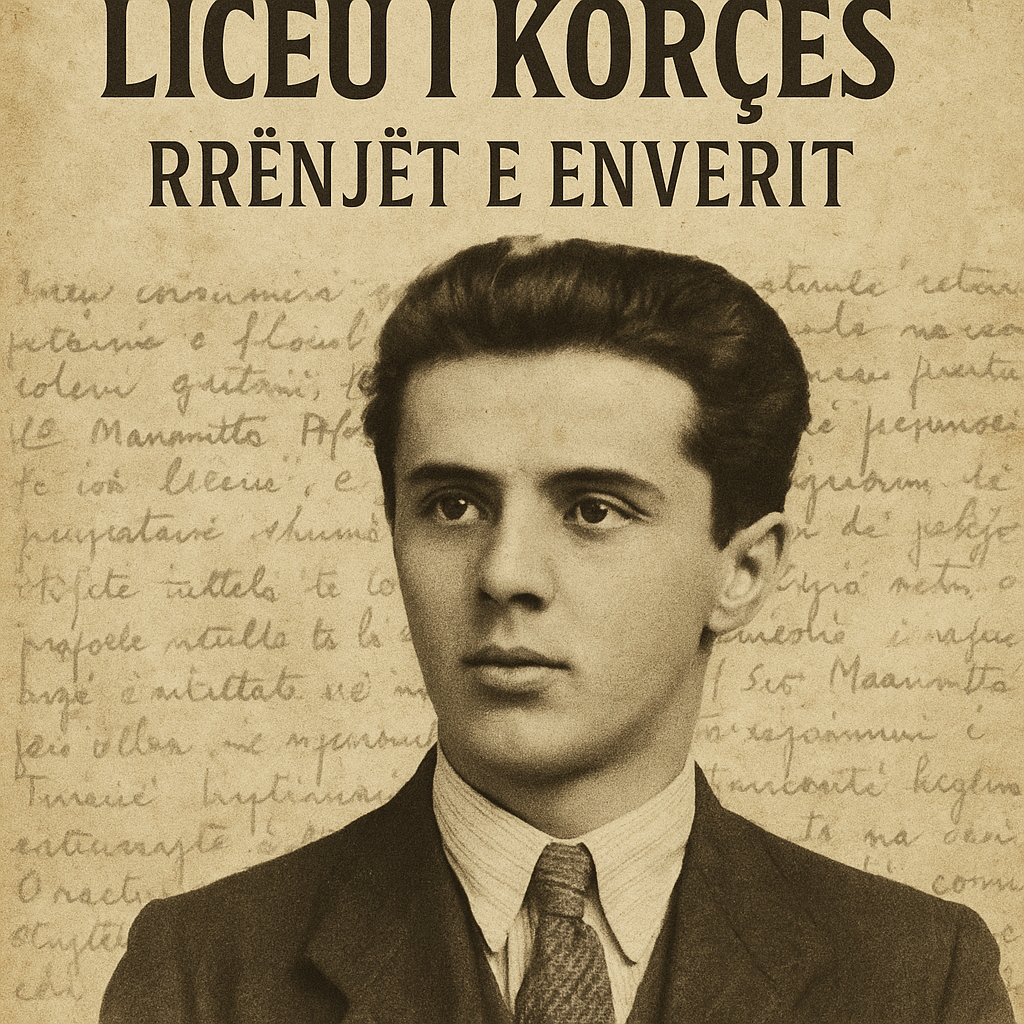
Source context: this account follows a 1973 narrative about Hoxha’s early life. Its favourable descriptions reflect the source’s political perspective.
From scholarship student to anti-fascist pedagogue – the full story of the Albanian leader’s early life
In a document from 1973, Albanian archives meticulously preserve memories and testimonies about one of the least documented, but most formative periods in Enver Hoxha’s life – his time as a student at the Korça Lyceum, later as a teacher, and then as a representative of left-wing thought and the anti-fascist movement.
The story begins in 1923 , when Enver begins high school at the newly opened Gjirokastra Lyceum. When this institution was closed in 1928 for financial reasons, he received a state scholarship and transferred to the Korça Lyceum .
🎓 Korça High School – School of critical thinking
In Korça, Enver stood out as a diligent student, especially in French and history. But, more than a good student, he quickly became an initiator of protests against injustices in the boarding school . When the food was bad or the heating was lacking, he was the one who led the collective reactions of the students. On one occasion, for his courage, he was expelled from the boarding school for several days , but this punishment only strengthened his reputation among the students.
He also helped his comrades read and understand French literature and political pamphlets that circulated from hand to hand in the lyceum , including texts on Lenin and the French Revolution.
✈️ Studies in France and Belgium – The beginning of the internationalization of ideas
After graduating from high school in 1930 , Enver received a scholarship to study in Montpellier , France, at the Faculty of Sciences. He later switched to law. In France and Belgium, he became acquainted with Marxist circles and began to collaborate with the newspaper “L’Humanité” of the French Communist Party, sending articles about Albania.
👨🏫 Return to Albania and teaching at the Korça High School
In 1936 , after a stay in Brussels as a consular secretary, Enver returned to Albania and initially taught in Tirana. He soon transferred to the Korça Lyceum , where he taught French and morals .
Students describe him as a special teacher: simple, approachable, without the usual arrogance of professors , who spoke frankly about morality, life, and the need for knowledge. In an episode with a rich and lazy student, Enver bursts into a speech that contained the essence of his ideology:
“This country does not need rich people who sit idle, but knowledgeable people who serve the people.”
📚 A free-thinking teacher
In the professors’ hall, Enver encounters an agent of the fascist newspaper “Gazeta Shqiptare” who asks for subscriptions. He replies:
“The Ministry has subscribed to us? Let it pay us itself!”
Likewise, when a French professor attempts to mock the Soviet Union’s military parade, Enver responds:
“A country that loves peace has the right to have a decent army to protect peace.”
🔥 Prelude to political action
Due to his activity in and outside of school, at the end of 1939 , Enver was fired from his job as a teacher . He then opened the “Flora” store in Tirana , which would become the center where the Albanian Communist Party would be formed on November 8, 1941 .
🗝️ Conclusion – Enver as a symbol of an era
From a scholarship student who raised his voice against spoiled food, to the leader of an entire political movement . This archival document testifies to how early ideas, painful experiences, and everyday honesty shaped the figure of Enver Hoxha, not only as a political leader, but as a product of a generation that learned, protested, and built from the ground up .