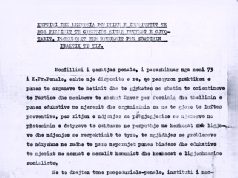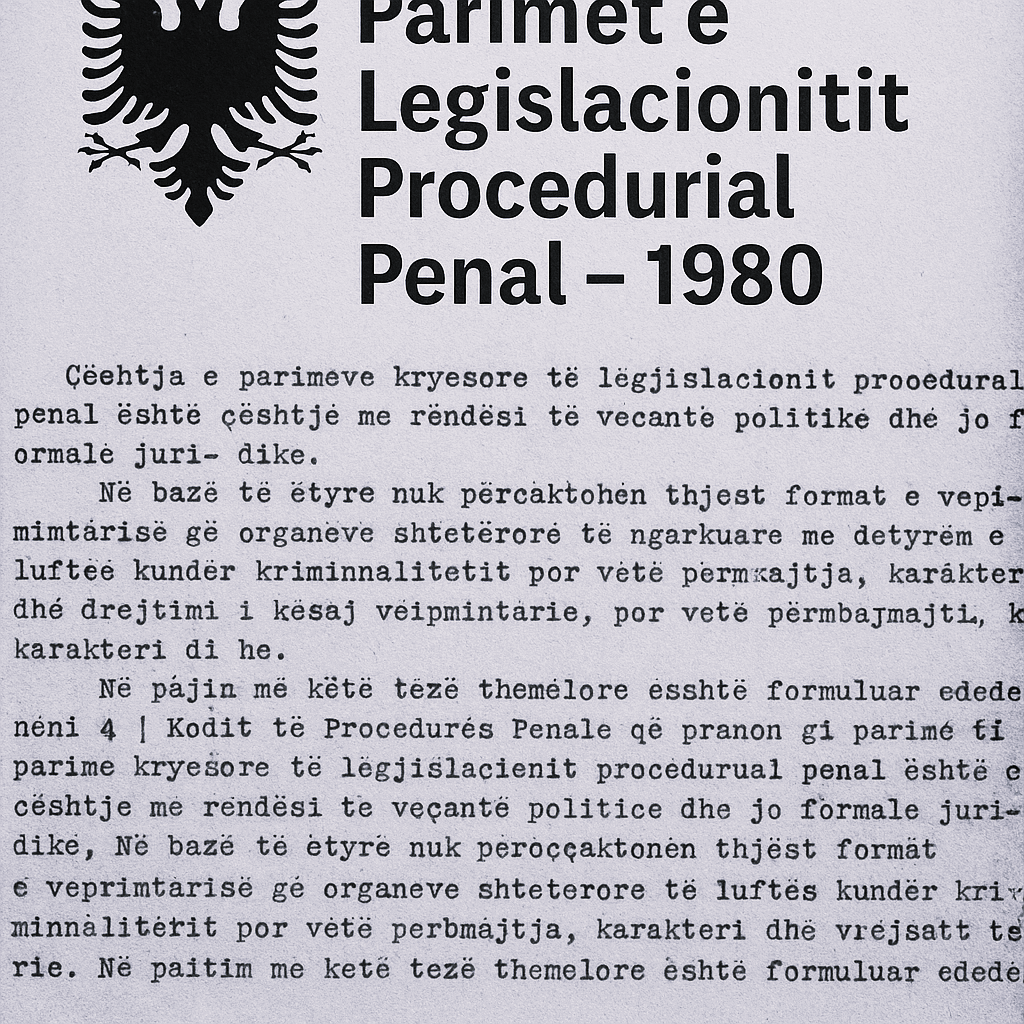
In 1980, Albanian jurists Grigor Gjika and Beon Kosta drafted a paper of doctrinal importance for the justice of the time: “Main Principles of Criminal Procedural Legislation”. It clearly defined that the criminal process was not simply a legal tool , but a political instrument of the dictatorship of the proletariat to guarantee the Party line, implement the class struggle and eliminate any manifestation of liberalism.
The principles were not formal, but political weapons
The paper begins with a basic thesis:
“The principles of criminal procedural legislation are not legal formalities, but ideological, political content, which serve to guide the fight against crime in a class sense.”
In this sense, justice was not neutral, but a tool of the ruling class to guarantee the socialist order and protect the state from bourgeois-revisionist degeneration .
Three basic principles mentioned in the Criminal Code of the time:
- Class struggle
- Mass line
- Socialist legality
🟥 1. The principle of class struggle: Justice as a continuation of political struggle
Article 4 of the Criminal Procedure Code stipulated:
“Criminal procedural legislation adheres to the principle of class struggle against criminal offense.”
This principle served:
- Defense of the Party and the state,
- The purge of foreign elements from the state apparatus,
- The growth of class consciousness.
The authors emphasize:
“Our justice has a political character, it is a tool in the fight against enemies, to prevent the restoration of capitalism.”
🟩 2. Mass line: Active participation of the people in justice
According to the paper:
“Only with the active participation of the working masses can the functions of our socialist state be successfully realized.”
For this reason, it was foreseen:
- Seeking the views of the masses before investigations,
- Popularization of judicial processes , to raise revolutionary consciousness,
- The role of public prosecutors and judges as the voice of the masses.
🟦 3. Socialist Legality: Law Enforcement as an Ideological Duty
“Socialist legality has nothing in common with legal formalism – it involves the correct application of the law in accordance with the Party’s political line.”
This principle required that every judicial body:
- To fulfill political duties,
- To avoid any tolerance towards liberalism,
- To organize procedures in accordance with socialist ideology.
Criticism of the “bourgeois” theory of justice
The authors rejected any formal concept of Western justice:
“The bourgeois theory of justice preaches form over content and aims to conceal the class nature of judicial processes.”
“Duel, judicial independence, and immutability – proclaimed as just principles in revisionist theory – are essentially nebulae that hinder the real understanding of the criminal process.”
Justice as the Party’s political line
The entire paper concludes with a conclusion that connects the penal system with the ideological spirit of the Party:
“The form and content of criminal proceedings do not stem from legal neutrality, but from the character of our state of the dictatorship of the proletariat.”
Presentation “Main Principles of Criminal Procedural Legislation”, authors: Grigor Gjika and Beon Kosta.