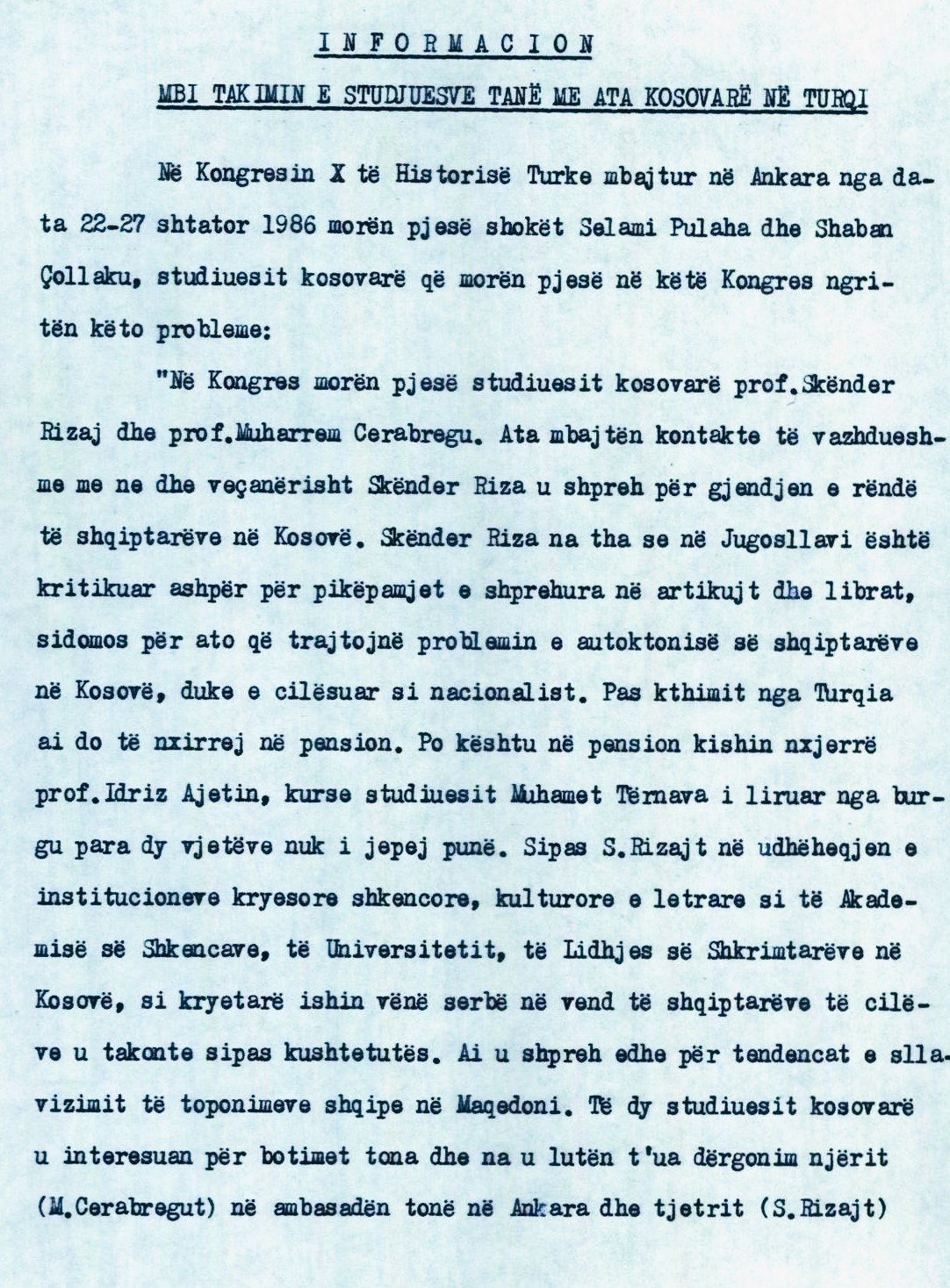
In September 1986 , during the 10th Turkish History Congress that took place in Ankara from September 22 to 27 , the Albanian delegation consisting of Selami Pulaha and Shaban Çollaku held important meetings with Kosovar scholars living and working in Yugoslavia.
According to archival information dated October 20, 1986 , prepared by the Sector for Propaganda Abroad , the congress was attended by Prof. Skënder Rizaj and Prof. Luharrem Cerabregu , who maintained close contacts with the Albanian representatives.
Concerns of Kosovar intellectuals
In the conversations held, Prof. Skënder Rizaj spoke openly about the plight of Albanians in Kosovo. He claimed that he had been severely criticized by the Yugoslav authorities for his scientific views, especially for his studies on the autochthonous nature of Albanians in Kosovo , which the regime described as “nationalist”. After his return from Turkey, he was expected to be forced into retirement .
Other prominent figures in Kosovar science were in the same situation: Prof. Idriz Ajeti had already retired, while researcher Muhamet Tërmava , just released from prison two years ago, could not find work . According to Rizaj, the leadership of the main scientific and cultural institutions – such as the Academy of Sciences of Kosovo , the University of Pristina , or the League of Writers of Kosovo – had come under the control of Serbs , replacing the Albanians who, according to the constitution, should have led them.
The risk of Slavization and the demands for cooperation
Another concern raised during the meeting was the trend towards the Slavicization of Albanian toponyms in Macedonia , which was part of a broader policy of cultural assimilation.
Both Kosovar scholars sought cooperation with Albanian publications and requested that books and scientific journals from Tirana be sent to them through diplomatic channels — specifically, for Prof. Cerabreg at the Albanian Embassy in Ankara and for Prof. Rizaj through the Bosnian scholar Ilijen Vasic .
They expressed satisfaction and gratitude for the fact that their articles and works were published in Albania , as well as for the positive reviews they received from Albanian scholars, seeing this as evidence of national support in times of isolation and persecution.
Conclusion
This 1986 document is a rare testament to the intellectual connections between Albania and Kosovo during the socialist Yugoslavia period . It clearly reveals the climate of political pressure on Albanian scientific thought in Kosovo, but also the enduring cultural connection that was maintained through scientific contacts, collaborations, and clandestine exchanges between intellectuals on both sides of the border.